How to Borrow Against Tokenized Stocks Without Selling Shares

How to Borrow Against Tokenized Stocks Without Selling Shares
Tokenized stocks are blockchain tokens that track shares of listed companies. Some DeFi lending markets accept them as collateral. A holder can then borrow stablecoins without selling. It covers platforms, loan math, costs, rules and risks. New readers can first read about real-world asset tokenization for background.
Key takeaways in brief
Tokenized stocks hold about $3.6 billion in value worldwide, per RWA.xyz data.
Kamino, Morpho and Ondo markets accept some tokenized stocks as collateral.
A recent Kamino market set the max loan-to-value at 30% to 40%.
The US stock market is open only about 19% of the week.
Loans can face forced sales, and many of these tokens carry no shareholder rights.
What It Means to Borrow Against Tokenized Stocks
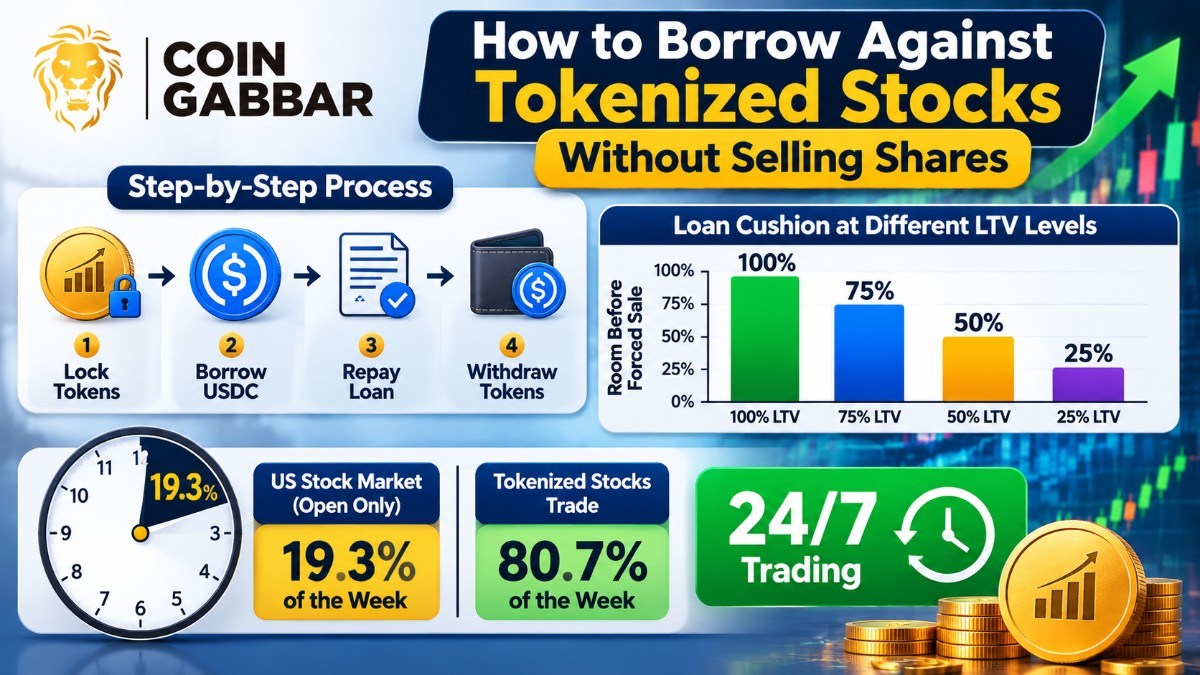
A broker margin loan lets an investor borrow against shares. DeFi works in a similar way. A user locks the tokens in a smart contract. The contract lends stablecoins, often USDC. The user keeps the stock exposure. The loan is repaid with interest to unlock the tokens.
If the stock falls too far, the contract sells part of the pledged tokens to cover the debt. That sale is a liquidation. Terms like these also appear in the crypto dictionary.
Tokenized Stocks Market Data as of 24 November 2026
Here are the freshest figures from named sources:
Market size. RWA.xyz tracked about $3.69 billion of tokenized stocks on 3 Nov, up 590% in 2026. A 20 Nov report put the figure near $3.6 billion.
Issuers. On 3 Nov, Ondo held $902.8 million and xStocks $596.8 million. Robinhood held $146.2 million and Coinbase $39.1 million. Binance bStocks led with about $1.4 billion.
xStocks today. RWA.xyz showed $648.1 million for xStocks on 23 Nov.
Holders. RWA.xyz counted 4.04 million holders with $3.16 billion at the time. That is about $780 per holder.
DeFi collateral. Token Terminal data shows $247.8 million of tokenized stocks in DeFi. That is up 19 times in a year. Kamino lending holds about $43.1 million of it.
How a Tokenized Stock Loan Works Step by Step
The flow is similar on most markets:
Pick a market and read its risk settings.
Check that the token and the user are eligible.
Deposit the tokenized stocks as collateral.
Borrow a stablecoin, up to the max loan-to-value.
Watch the loan-to-value each day.
Repay the loan with interest, then withdraw the collateral.
Here is a simple example. A holder locks $10,000 of a token on a market with 40% max loan-to-value. The cap is $4,000. A $2,000 loan sets the loan-to-value at 20%.
LTV and Liquidation Math With Real Market Settings
The Backpack Market gives real settings. MU and SKHY have 40% max LTV and a 60% liquidation threshold. SPCX and SNDK have 30% and 50%.
The room before a forced sale follows a simple rule. It equals one minus LTV divided by the liquidation threshold. The table ignores interest.
Market | Borrow at max | 75% of max | 50% of max | 25% of max |
MU and SKHY (40% and 60%) | 33.3% | 50.0% | 66.7% | 83.3% |
SPCX and SNDK (30% and 50%) | 40.0% | 55.0% | 70.0% | 85.0% |
Each cell shows how far the stock can fall before a forced sale. A user at max LTV on MU has a 33.3% cushion. At half of max, the cushion grows to 66.7%.
Backing needs differ too. A $1,000 loan needs $3,333 of pledged tokens at 30% LTV. It needs $2,500 at 40% LTV. A 50% margin rule, common at brokers, needs only $2,000.
A forced sale is partial at first. By default, one round closes 20% of the debt. Above a market threshold, typically 95% LTV, the whole position can be sold at once. The liquidation bonus also grows as the breach gets deeper. The Kamino liquidation docs explain each step.
Costs Compared: DeFi Loans vs Broker Margin Loans
Rates move often. Here are recent published figures:
Interactive Brokers Pro. On 13 Nov, margin cost 5.38% at $25,000 and 5.05% at $300,000.
Schwab. The same day, margin cost 11.58% at $25,000 and 10.33% at $300,000.
Securities-backed lines. On 9 Nov, a $1 million draw cost about 4.93% at IBKR. Fidelity charged 6.23% and Schwab 6.78%.
Fed policy. The Fed raised its target to 3.75%-4.00% on 16 Sept and held it on 28 Oct.
Kamino USDC. The variable borrow rate was near 1.20% on 28 Oct.
The next table shows the yearly interest on a $3,000 loan. It also shows the backing each model needs.
Model | Rate | Yearly interest | Backing needed |
Kamino USDC (about 28 Oct) | 1.20% | $36.00 | $7,500 to $10,000 |
IBKR Pro (13 Nov) | 5.38% | $161.40 | $6,000 at 50% margin |
Schwab (13 Nov) | 11.58% | $347.40 | $6,000 at 50% margin |
The DeFi rate looks low, but it is not a fair win. It is variable and changes with pool use. The pool also had a 3 million USDC cap. A borrower must lock more tokens, and forced sales are automatic. The IBKR margin rates page and the Kamino docs show current numbers.
Market Hours, Oracles and Weekend Price Gap Risk
US stocks trade from 9:30 to 16:00 Eastern. That is 32.5 hours of a 168-hour week, or 19.3%. The market is closed the other 80.7%. It is shut for 16 hours on weekdays and all weekend.
The tokens trade around the clock. During closed hours, no main reference price exists, so token prices can drift from the last close. A loan market needs a rule for these hours.
Key Risks Before Borrowing Against Tokenized Stocks
Reports on the Morpho launch note three layers of risk. They are smart contract risk, issuer risk and market risk. The main risks are:
Forced sale. A fast fall in the stock can wipe out the cushion.
Oracle gaps. A stale price can fail at the open.
Issuer risk. A token is only as sound as its issuer and custodian.
Rate risk. A variable rate can jump when the pool fills up.
Leverage. Kamino xStocks strategies allow up to 3.7x leverage, which magnifies losses.
Thin liquidity. Only a small share of tokens sits in DeFi, so exits can be costly.
Rights and rules. Eligibility, dividends and taxes differ by token and by country.
Safe habits matter here. The crypto listing alerts guide shows how to track loan levels.
The crypto wallet security tips cover wallet safety.
Author Perspective: A Cautious Borrowing Framework
From an outside view, borrowing against tokenized stocks suits only careful users. The market is young, and fresh rewards can hide real risk. A cautious plan borrows far below the cap. At half of max LTV on a 40% and 60% market, the cushion is 66.7%. That is double the cushion at the max.