Incentiv CENT Explained: How Token Fees, Rewards, and Supply Work

How Does Incentiv CENT Use Fees, Rewards, and Its 100B Token Supply?
What does a blockchain token do when users can pay fees in other assets and still earn rewards? That question sits at the center of Incentiv CENT.
The $CENT token is the native asset of Incentiv, an EVM-compatible proof-of-work network built around account abstraction.
The project says $CENT settles network fees and funds rewards for useful activity.
Newcomers often confuse fee tokens, reward tokens, and supply figures, so each gets its own section.
What Is Incentiv CENT in Simple Terms?
Incentiv CENT is the native token of the Incentiv blockchain. A native token is the asset a network uses for its own core jobs, such as paying for transactions.
Incentiv is a live Layer 1 blockchain, which means it runs as its own base network instead of sitting on top of another chain. It is secured by Proof-of-Work mining. It is also EVM-compatible, so apps written in Solidity can use familiar developer tools.
The standout feature is native account abstraction. Wallets are programmable smart contracts, so apps can sponsor fees, set spending limits, or add recovery options.
The project also describes a future where AI agents hold budgets and pay for services onchain. That is a stated direction, not a confirmed result.
How Do Incentiv CENT Token Fees Work?
Fees follow standard gas mechanics. The documentation gives the formula as gas used multiplied by gas price, with a target of about $0.03 for a simple transfer. Its own example puts a 550,000-gas-user operation at roughly 45.93 CENT.
Holding the token first is not always required. Under the Unified Token system, a user can pay gas in another supported asset.
A paymaster, which is a contract that pays gas on a user's behalf, fronts the fee. The protocol then swaps the payment into $CENT using its native exchange.
The fee currency can vary. The settlement asset stays the same. That is the core job of Incentiv CENT in the fee system.
Where Does Each Fee Go?
Every fee splits automatically into two streams.
Fee stream | Share | Recipient |
Block reward | 12.5% | Block producer |
Unified reward pool | 87.5% | Weekly contributor rewards |
The project whitepaper from September 2025 described a value-based fee tied to transaction amounts. The newer documentation says the live design uses gas-based fees and keeps the older idea as a possible governance change. The documentation is the more recent reference.
How Do Incentiv+ Rewards Distribute the Fee Pool?
Incentiv+ is the reward engine. It scores five roles on measurable activity, pays out weekly, then resets scores. Each role competes only inside its own group.
Role | Listed share | Main scoring inputs |
Developers | 28% | Volume, transactions, unique wallets |
Liquidity providers | 20% | Volume, duration, capital deployed |
Users | 18% | Volume, frequency, fees paid, dApp diversity |
Miners (participation) | 12.5% | Uptime, reliable block production |
Bundlers | 9% | Operations processed, gas efficiency |
The documentation labels these figures as pool shares. They only reach 100% when added to the 12.5% block reward and counted against total fees. The Economic Engine documentation is the place to check for updates.
Epoch 0 works differently. It is a separate, token-funded program. The project lists a 250 million CENT base allocation plus up to 50 million reserved CENT.
Participation closes on 30 November 2026 at 10:00 UTC. Allocations then face a three-month cliff and 12 months of linear vesting.
Cashback adds another layer. The project says it pays 50% of gas on qualifying Portal transactions after the first 100 each day.
It is credited to a reserved balance, not paid as a spendable refund. A higher XP tier changes score weight, not a fixed token amount.
Incentiv CENT rewards therefore flow through two channels: the weekly fee pool and time-limited programs.
How Is the Incentiv for CENT Supply Allocated?
The published tokenomics show a fixed total supply of 100 billion CENT across five allocations. The white paper adds that no new tokens are minted once the initial allocations are distributed, so the Incentiv CENT supply is capped.
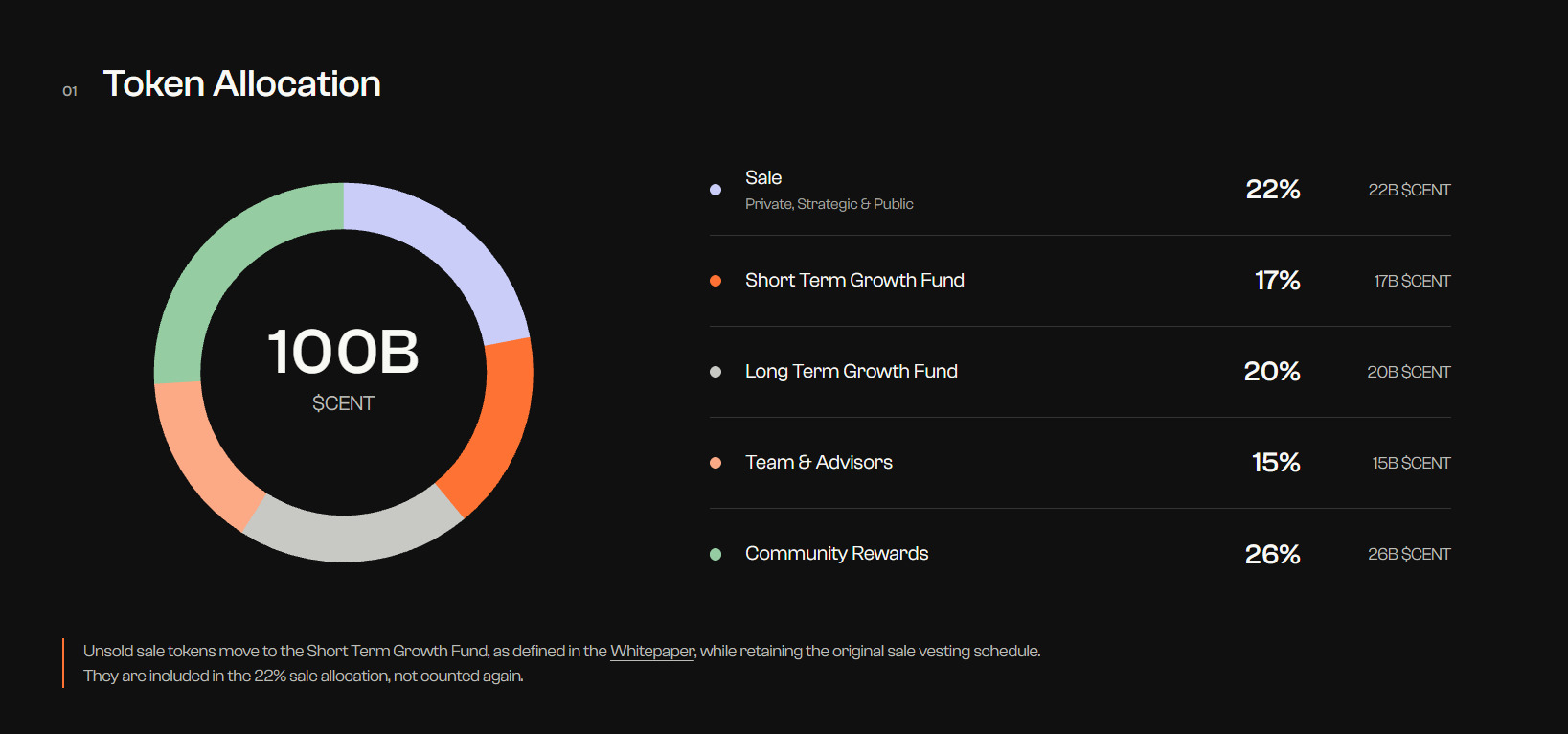
Allocation | Share | Tokens | Release rule |
Sale (private, strategic, public) | 22% | 22B | Six-month cliff, then 12 monthly releases |
Short Term Growth Fund | 17% | 17B | 20% at launch, the rest over 24 months |
Long-Term Growth Fund | 20% | 20B | Spread over 60 months |
Team and Advisors | 15% | 15B | 12-month cliff, then 24 monthly releases |
Community Rewards | 26% | 26B | 60 months, front-loaded, tapering |
A token vesting schedule is the timetable that controls when allocated tokens become available. It matters because large releases can add selling pressure.
Community Rewards also leans toward the early months. Releases start strong to pull in users and builders, then taper off as the network matures. Team and advisor tokens wait out a 12-month lock before anything moves. Sale tokens clear faster than most, finishing by month 18 while the full schedule runs to month 60.
The Short Term Growth Fund starts with 20% available at launch, about 3.4 billion tokens. It also absorbs any unsold sale tokens, which keep the vesting terms they were originally given.
What Do the Incentiv CENT Market Numbers Show?
In that snapshot, a market data platform listed a price near $0.0027, a market cap of $26.59 million, and an FDV of $271.3 million. Circulating supply stood at 9.8 billion cents, about 9.8% of the total.
Market cap multiplies price by circulating supply. FDV, or fully diluted valuation, multiplies price by total supply. For Incentiv CENT, the second figure is roughly ten times the first. That gap shows how much supply is still scheduled for release.
Volatility is visible too. The same data shows a price range of about $0.00125 to $0.0046 in recent weeks.
Daily volume was near $918,000, around 3.4% of market cap. The official CENT page lists CENT/USDT pairs on several centralized exchanges, including spot and perpetual markets.
What Risks Come With Incentiv CENT?
Several risks sit behind the Incentiv CENT numbers.
Supply overhang: Roughly 90% of tokens were not circulating in the snapshot, and releases run to month 60.
Subsidy dependence: Rewards are meant to shift from token-funded to fee-funded. The project calls that a goal, not a result.
Early-stage design: The whitepaper says specifications, features, and timelines may change.
Program limits: Epoch 0 terms apply to that epoch only, and future carryover has not been announced.
Verification gaps: The pages reviewed here held no audit report. An audit is not a guarantee of safety, and the whitepaper notes access may be restricted in some regions.
What Should Be Tracked Next for Incentiv CENT?
Three signals will say more than any price chart. First, whether weekly fee revenue grows enough to replace token subsidies. Second, how circulating supply changes against the token unlock schedule. Third, whether activity holds after Epoch 0 closes.
Proof-of-Work mining matters too. Miners earn from fees rather than newly issued block subsidies, so fee volume drives security spending. That link is untested at scale.
Conclusion
Incentiv CENT is the settlement token of a proof-of-work network built around smart-contract crypto wallets. Fees are split between miners and a weekly reward pool, while a fixed 100 billion supply is released over 60 months.
For Incentiv CENT, the fee-funded reward design stands out. Whether real usage can replace token subsidies on schedule remains uncertain. The tokenomics page, the documentation, and the live supply data deserve a direct check before any decision.
Disclaimer:
This article is for information only and is not financial advice. Crypto assets are volatile and carry a high risk of loss. Readers should research independently and confirm current figures on official pages before acting.