Injective Bitnomial Futures: Could INJ Be Next for a Staked ETF?

Injective Bitnomial Futures: Can INJ Clear the Path to a Staked ETF?
Derivatives for INJ listed in the US have now traded for more than six months, and that milestone matters for the next big step: a staked INJ exchange-traded fund.
The Injective Bitnomial futures went live in April on a federally supervised exchange, giving institutions a familiar way to trade the token.
Here is a plain-language guide to how the contracts work, why six months matters, and what is still not confirmed.
What Six Months of Trading Means
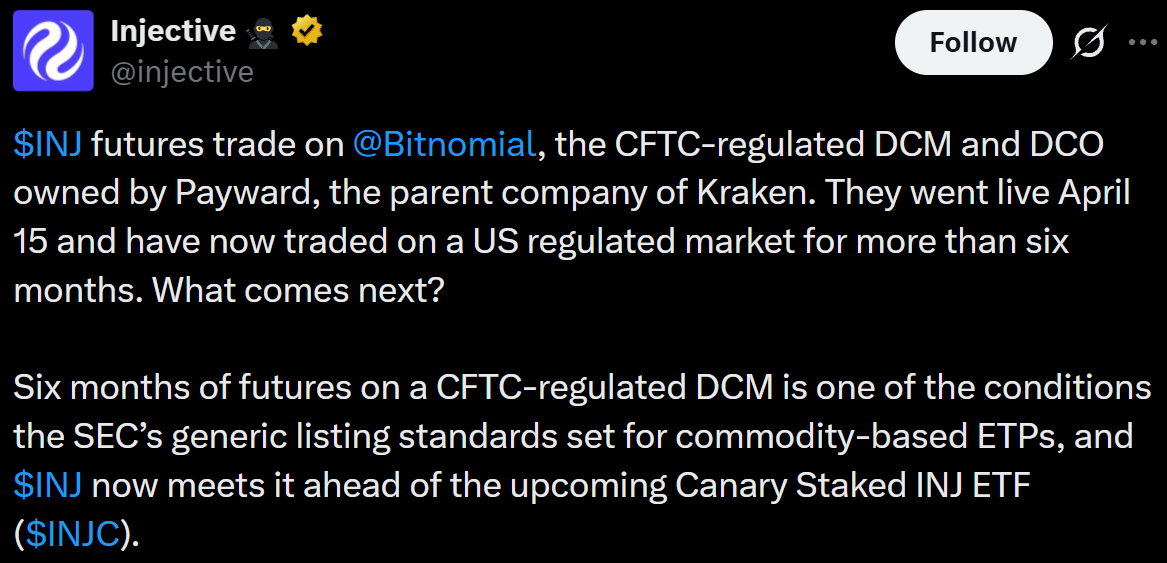
On 15 April 2026, US-regulated INJ futures began trading on Bitnomial Exchange, a designated contract market overseen by the CFTC.
Bitnomial is also a clearinghouse and is owned by Payward, the parent company of Kraken.
Counting from the launch date, the contracts passed the six-month mark in mid-October.
Under the SEC’s generic listing standards, approved in September 2025, a commodity-backed product can list without individual SEC review once its underlying asset has had futures on a CFTC-regulated market for at least six months.
That history is one of several conditions, so meeting it does not guarantee a listing.
The reason these contracts matter: many institutions cannot hold tokens directly because of compliance, custody, and internal risk rules, while a CFTC-overseen contract comes with clearing, margin and counterparty protections already built in.
| Milestone | Detail |
| Contract launch | 15 April 2026 |
| Venue | Bitnomial Exchange, CFTC-regulated |
| Six months reached | Mid-October 2026 |
| Product status | Filed, not yet confirmed as listed |
How the Contracts Work
Institutions trade through Bitnomial’s clearing member brokers. Each contract settles in the crypto itself and expires monthly.
Traders can post crypto or US dollars as margin through Bitnomial Clearinghouse, so they can fund positions with assets they already hold instead of selling them first.
Hedge funds, prop desks, and family offices can use them to gain exposure, hedge, or build portfolio strategies.
Retail access was planned through Bitnomial’s Botanical platform, and perpetual contracts and options were announced as the next products.
Availability can change, so traders should confirm current offerings directly with the exchange.
The Path to a Staked INJ ETF
Canary Capital filed an S-1 with the SEC in July 2025 for the Canary Staked INJ ETF, proposed to list on Cboe BZX.
BitGo Trust Company is named as custodian and U.S. Bancorp Fund Services as transfer agent, while Cboe filed the matching 19b-4 application the same month.
The ETF would stake its holdings and earn rewards on top of price exposure, a feature that sets it apart from most crypto proposals. A European product from 21Shares, called AINJ, already exists.
The ticker INJC has been referenced for the product, though a listing date has not been confirmed. Nothing here guarantees approval or a launch.
Two Products, Two Types of Investor
The two products solve different problems, and the difference is easy to miss.
| Feature | Futures | Proposed staked ETF |
| Main user | Institutions and, later, retail traders | US investors with a brokerage account |
| What you get | Exposure to price moves | Ownership of staked INJ through ETF shares |
| Settlement | Crypto-settled, monthly | Rewards restaked into the fund’s value |
| Status | Live | Filed, listing pending |
In short, the Injective Bitnomial futures give US institutions a supervised way to trade INJ, while INJC is designed to give investors a regulated way to own it, staked, in the same account they use for other holdings.
-
Contracts suit hedging and portfolio strategies
-
The product suits long-term holders who prefer a brokerage account
-
Neither product removes market risk
Injective’s Institutional Push
The stack of regulated products around the token keeps growing. In August 2026, Injective Institutional Services registered with the SEC as a transfer agent, a step meant to bring regulated and tokenized markets onchain.
The network itself is a Layer 1 built for finance, with an on-chain order book, sub-second finality, and links to Ethereum and Solana.
Validators such as Google Cloud and Binance already signal institutional interest. CME Group lists derivatives for Bitcoin, Ether, Solana, and other top crypto assets, and INJ now joins a small group with CFTC-listed contracts.
A native EVM mainnet arrived in November 2025 to widen compatibility for developers and institutions.
Listed derivatives, institutional-grade validators, and an active ETF filing now sit side by side, which explains why the Injective Bitnomial futures milestone draws attention beyond derivatives traders.
Conclusion
The Injective Bitnomial futures have cleared an important regulatory hurdle, and the staked ETF filing is the next chapter to watch. Still, no listing date, approval, or price effect is confirmed.
Follow official channels, check the exchange for live product details, and remember that this article is not financial advice.
Disclaimer
This article is for educational and informational purposes only and is not financial or investment advice. Crypto assets are high risk, their prices can be very volatile, and you can lose some or all of your money. Always do your own research and consider speaking with a licensed financial advisor before making investment decisions.









