MiCA Stablecoin Rules Explained: What's Legal in the EU Now

What MiCA Stablecoin Rules Mean for Crypto Users in the EU
MiCA stablecoin rules now decide which tokens pegged to a currency can be issued, offered, and traded across the European Union, and the market has operated under them in full since 1 July 2026.
The Markets in Crypto-Assets Regulation, known as MiCA, replaced a patchwork of national approaches with one licensing system for all 27 member states.
Readers following EU MiCA news usually want to know which stablecoins remain legal, and the answer depends on the issuer's authorization and the platform's license. This guide reflects information current as of November 2026.
What Is MiCA and Why Does It Matter for Stablecoins?
MiCA, formally Regulation (EU) 2023/1114, entered into force on 29 June 2023 and anchors European crypto regulation by covering crypto-assets that older financial laws never addressed. Stablecoins received dedicated chapters because stable-value tokens can touch payments and financial stability. The main features of the MiCA regulation include:
One EU-wide rulebook with passporting, which lets a firm authorized in one member state serve clients in all the others.
Separate authorization routes for token issuers and for crypto-asset service providers, a group covering exchanges, custodians, and brokers.
Mandatory white papers, which are disclosure documents describing a token, its risks, and its reserves.
Reserve, custody, and redemption rules designed to protect holders if an issuer fails.
A public register kept by ESMA, the European Securities and Markets Authority.
What Are the Two Types of Stablecoins Under MiCA?
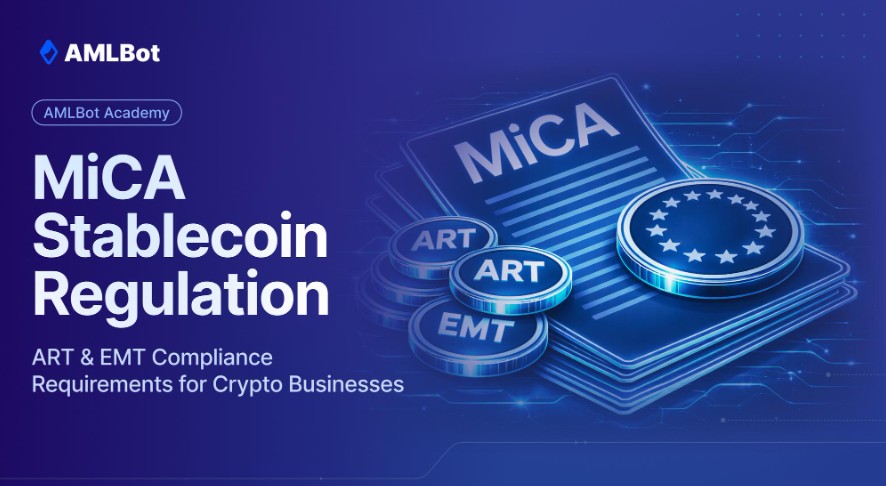
MiCA puts every regulated stablecoin into one of two boxes, and the box depends on how the coin is built.
What Are E-Money Tokens (EMTs)?
An EMT is a stablecoin tied to one official currency, such as the euro or US dollar. USDC is one example. Only credit or electronic money institutions can issue them. Under the MiCA stablecoin rules, holders can redeem an EMT at face value, and issuers cannot pay interest on it.
What Are Asset-Referenced Tokens (ARTs)?
An ART follows a basket of assets, such as currencies or commodities, instead of a single currency. Since that value is harder to keep steady, issuers face stricter capital and governance duties. Register data from August 2026 showed no authorized ART issuer in the EU, so most coins sit in the EMT box.
What Are the MiCA Stablecoin Requirements in 2026?
The MiCA stablecoin requirements apply to issuers and to the platforms that list their tokens. Issuers must obtain authorization, publish a white paper, hold matching reserves separate from company assets, and honor redemption requests at par value.
Platforms need a MiCA crypto license before offering trading custody or transfer services, which places EU MiCA crypto licensing at the center of every crypto exchange Europe users rely on.
ESMA stablecoin guidelines add practical detail on supervision. In January 2025, ESMA and the European Commission published guidance on non-compliant ARTs and EMTs, expecting platforms to restrict related services.
An ESMA statement dated 8 October 2026 then set out expectations for services connected to unauthorised stablecoins, while noting that not every such service counts automatically as a public offer.
Which Stablecoins Are Legal in the EU Under MiCA?
Legal status depends on the issuer's authorization, not a token's size. USDC and EURC are the best-known MiCA-compliant stablecoins, issued by an electronic money institution licensed in France, while euro tokens such as EURI have been authorized through other national regulators.
USDT has not secured authorization, and market reports say regulated platforms limited it for EU customers after the ESMA guidance.
A platform can list a token only if both the token and the platform meet the requirements, so MiCA stablecoin rules effectively filter what reaches EU users.
Readers can verify any token through the ESMA interim register, which shows authorized issuers, licensed service providers, and white paper status.
What Changed in EU Stablecoin Rules in 2026?
The biggest change was the MiCA stablecoin deadline of 1 July 2026, when the grandfathering window under Article 143(3) closed. Firms operating under national registrations before December 2024 needed a granted authorization by that date, because a pending application did not extend the window.
Unauthorized providers were expected to complete a wind-down plan, and several member states had ended their own grace periods earlier.
A second change arrived on 1 March 2026, when EBA guidance clarified how MiCA overlaps with the Payment Services Directive. EMT transfers made on behalf of clients can qualify as payment services, which pushed providers toward an extra authorization.
Since the MiCA stablecoin rules took full effect, each EU MiCA regulation update has focused on supervision, and recent EU MiCA regulation news points the same way.
Causes and Risks Behind the New EU Stablecoin Regulations
Regulators moved because a failed reserve could damage payments, savings, and confidence in the wider crypto market. EU stablecoin regulations borrow the logic of e-money safeguards. The framework still carries risks that readers should weigh:
Platform risk: an unlicensed provider may stop services or wind down, which can force clients to move funds.
Availability risk: a compliant token is not automatically listed everywhere, since each platform chooses its own assets.
Classification risk: borderline designs can be reviewed differently by national authorities, and the absence of authorized ARTs leaves that category untested.
Information risk: items labelled EU MiCA prediction market news often mix forecasts with official positions, so only published regulator statements count as confirmed rules.
Expert Take: What Should Readers Watch?
The stronger signal is the growth of authorized issuers, since a wider pool of EMTs gives EU users more choice.
The main concern under the MiCA stablecoin rules and the MiCA regulation 2026 framework is the thin supply of authorized options, because no ART issuer has appeared and few dollar tokens hold approval.
The biggest unknown is how supervisors will apply the October 2026 statement, and the next EU MiCA update from ESMA could clarify that.
Readers should check the ESMA register, the white paper, and the platform's license before relying on any token.
Conclusion
MiCA stablecoin rules set a clear test for any token in Europe: an authorized issuer, a licensed platform, a published white paper, and redeemable reserves. EMTs dominate the compliant market, ARTs remain absent, and the July 2026 deadline ended the grace period for service providers.
What remains uncertain is how supervisors will apply guidance on unauthorized tokens, so checking official registers is the sensible next step.
Disclaimer
This article is for informational purposes only and does not constitute financial, legal, or investment advice. Crypto assets carry high risk, and regulations can change. Readers should consult qualified professionals and verify details with official sources before making decisions.