Phina Network Presale Guide: How to Buy PHN Tokens and Verify Details

What Are the Steps to Buy PHN Token in the Phina Network Presale?
Phina Network is running a live presale on BNB Smart Chain, and first-time buyers tend to get stuck on the same questions. Which wallet works? Which coin pays for it? How can someone tell the real site from a copy? This guide answers each one in order. It follows the five steps shown on the official site, adds the numbers worth checking, and lists the risks that come with any presale. Prices and progress change, so the live page always has the final word.
Key Takeaways
Buying PHN takes five steps: set up a wallet, add BNB, choose a currency, confirm, and receive the tokens.
The presale accepts BNB, USDT and USDC, and the listed price is $0.31 per PHN.
The contract address must match the official one before any payment is made.
What Is Phina Network?
Phina Network is a Web3 gaming ecosystem built on BNB Smart Chain. It mixes decentralized finance with games, so players can earn tokens while they play.
Its native token is PHN, a BEP-20 token used for governance, staking and the in-game economy. A second token, PHNA, serves as the platform token.
Source: official website
The Phina Network Ecosystem in Three Layers
The Phina network ecosystem has three parts, and each one gives PHN a reason to exist.
Layer | What happens there |
Play | Players join games and tournaments and earn rewards |
Stake | Holders lock for rewards, with four ranks from Rookie to Legend based on the amount staked |
Build | Phina Lab lets users create tokens, build DApps, launch presales, add liquidity and trade |
Phina Lab shows figures such as 1,500 projects and 17,000 users. These numbers are self-reported, so on-chain data on BscScan is the better place to check real activity.
Source: official Phina Network documentations
How Does the Phina Network Presale Work?
The presale runs on the project’s official website, and buyers join through a presale card. The sale covers 20% of the total supply, which is 40,000,000 PHN. The progress bar showed 70% when last checked.
The process has four parts:
Contribution. A buyer enters an amount of BNB, USDT or USDC in the presale card.
Approval. The buyer approves the transaction in the wallet and adds a receive address for the tokens.
Allocation. The tokens are allocated once the transaction is confirmed on-chain.
After the sale. The Phina Network roadmap lists a token generation event, CEX and DEX listings and a first staking release, though dates differ between sources.
Presale Price and Key Numbers
Detail | What the site shows |
Listing price | 1 PHN = $0.31 USDT |
Payment options | BNB, USDT, USDC |
BNB rate | 1 BNB = 153,990 PHN (BNB at about $769.95) |
Presale allocation | 20% of supply, or 40,000,000 PHN |
Progress | 70% when last checked |
Source: official presale page
The Phina Network presale price needs a careful read. The BNB rate works out to roughly $0.005 per PHN, far below the $0.31 listing price. The site does not explain that gap, and earlier pages showed $0.30. Anyone planning to buy PHN token should confirm the exact figure on the live presale card before approving a payment.
How to Buy PHN Presale: Five Steps
This PHN token purchase guide follows the order shown on the official site.
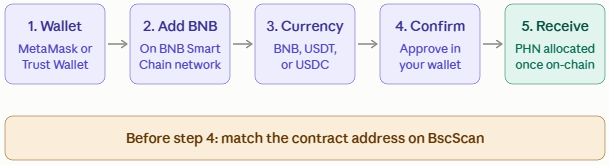
Step 1: Set Up a Wallet
Install MetaMask or Trust Wallet and create a wallet. Keep the seed phrase safe and private, because anyone who holds it controls the funds. Then copy the website link and open it inside the wallet’s dApp browser.
Step 2: Add BNB to the Wallet
Buy BNB on an exchange, then transfer it to the wallet on the BNB-Smart Chain network. Choosing a different network at withdrawal is a common way to lose funds, so that field deserves a second look.
Step 3: Choose a Currency
Enter the amount of BNB, USDT or USDC to contribute in the pre-sale card. The card shows the amount that matches the entry, and that figure should be checked before moving on.
Step 4: Confirm the Transaction
Review the details and approve the transaction in the wallet. The process also asks for a receive address for the PHN tokens.
Step 5: Receive PHN
The tokens are allocated once the transaction is confirmed on-chain. The transaction hash can be searched on BscScan to confirm that it went through.
The Buying Path at a Glance
Step | Where | Keep ready | Watch for |
1. Wallet | MetaMask or Trust Wallet | Seed phrase stored safely | Fake wallet apps |
2. BNB | Exchange, then wallet | BNB on BNB-Smart Chain | Wrong network |
3. Currency | Presale card | BNB, USDT or USDC | Price and amount |
4. Confirm | Wallet approval | Receive address | Unknown pop-ups |
5. Receive | On-chain | Transaction hash | Delays or errors |
Which Currency Fits Best?
Option | How it behaves | Worth knowing |
BNB | Its dollar value moves with the market | Also pays network fees on BNB Smart Chain |
USDT | A stablecoin tied to the US dollar | A small BNB-balance is still needed for fees |
USDC | A stablecoin tied to the US dollar | A small BNB-balance is still needed for fees |
Stablecoins keep the amount spent steady in dollar terms. BNB suits buyers who already hold it. In every case, a little extra BNB should stay in the wallet to cover fees.
Verify Before Paying
Fake sites and copied contracts are common around presales. The official page lists one contract for each token, both on BNB Smart Chain (BEP-20).
Token | Role | Contract address |
PHN | Native token | 0x7d007dC77a8F6333Ed71EFbfB13C21D6C1339425 |
PHNA | Platform token | 0xbC6528f5697944c69b3007c2A32521AF0F81A00e |
Copy the address from the official page instead of typing it. Then open it on BscScan and check that the token name and supply match the project’s stated figures: 200,000,000 PHN and 100,000,000 PHNA.
Risks Worth Knowing
Presale risk. Early-stage tokens can lose value quickly, and the listing price is not guaranteed.
Self-reported claims. Audits, platform stats and the “backed by Trust Wallet” line come from the project itself and need independent proof.
Supply questions. PHN shows 100,000,000 coins as circulating while the sale is still running, which is a fair question for the team.
Look-alike sites. Any link that does not lead to the official website should be treated as unsafe.
Final Word
The buying process itself is simple. Most mistakes happen before it: the wrong network, the wrong site or an unchecked contract. A buyer who verifies the address, confirms the live price and risks only what can be lost has covered most of what a presale guide can offer.
Disclaimer: This article is for information only and is not financial, investment, tax or legal advice. Crypto presales carry a high risk, including total loss. Details come from the project’s public pages and may change, so readers should verify everything themselves.