Polygon Stablecoin Supply: Can $3T in Payments Drive the Next Growth?


Polygon Stablecoin Supply: What 8.35 Billion Transactions Reveal
The Polygon stablecoin supply story is back in focus as fresh network data shows how heavily the blockchain is used.
According to the latest analytics reading, it has processed about 8.35 billion transactions since it launched on May 30, 2020.
That places it among the busiest blockchains ever built.
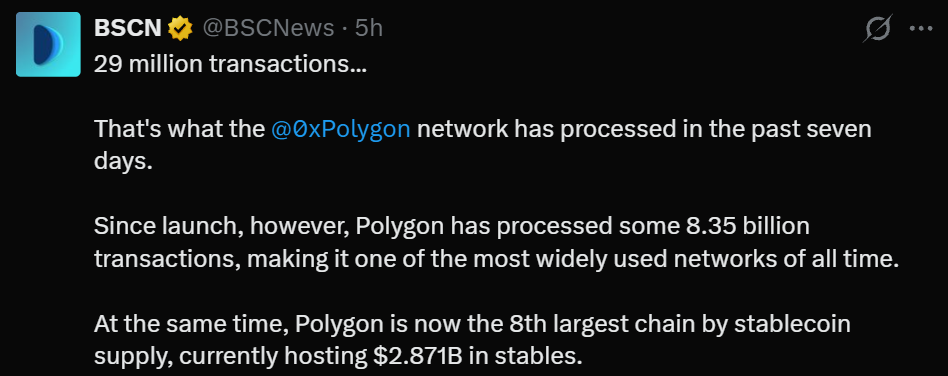
Source: BSCNews Post
How Big Is the Network’s Total Activity?
The same analytics page shows a running total of roughly 8.35 billion transactions.
A transaction is simply one action, such as sending a token, swapping coins or paying for a service.
Because the count started in 2020, it reflects more than six years of steady use. For context, 8.35 billion is a lifetime figure, so it grows every second and should never be read as a one-day result.
At the latest reading, the system was handling about 47.8 actions every second, or roughly 172,000 in one hour.
A quick calculation helps here: if that hourly pace held for a full week, the total would land near 29 million.
Please treat this as an estimate built from one hourly reading, not as an official weekly count. Live numbers change every minute.
Live Snapshot at a Glance
The table below turns the latest readings into plain facts.
Metric | Latest Reading | Plain Meaning |
Total activity since launch | 8.35 billion | Count since May 30, 2020 |
Speed, 1-hour average | 47.8 per second | Current pace of use |
Peak speed, last 100 blocks | 537.5 per second | A short burst of high use |
Theoretical capacity | 3,810 per second | Upper limit of the current design |
Block time | 1.5 seconds | How often a new block arrives |
Finality | 5 seconds | Time until a payment is settled |
Average fee, 1 day | $0.0085 | Less than one cent per action |
Validators | 100 | Computers that help secure the system |
Readings are live and may differ when you check.
In simple terms, finality is the time after which a payment is treated as settled, and the fee is what a user pays for each action.
A one-and-a-half second block time with five-second finality and a fee under one cent suits small, frequent payments.
These are the traits that make a blockchain practical for everyday transfers.
Why Polygon Stablecoin Supply Matters for Payments
Stablecoins are digital tokens built to hold a steady value, usually one US dollar. Because their price does not swing like Bitcoin, people use them for payments, salaries and money transfers.
Polygon stablecoin supply shows how many of these tokens currently sit on the network, and a larger figure usually means more money is ready to move.
It helps to separate two ideas. Transaction count measures how busy a network is, while supply measures how much value is parked on it.
A system can be very busy with a modest balance, which is why both numbers should be read together.
The project’s own stablecoin page says sending USDC costs about $0.0008. Its official project overview lists stablecoin liquidity on the main blockchain at more than $3.4 billion.
Different trackers count tokens in different ways, so supply figures can vary. Always compare the date and the method before quoting any number.
Official Records Behind the Growth
The team behind the project, Polygon Labs, lists its own milestones on its official website.
The key records are:
94 million stablecoin transfers in a single day, recorded on February 10, 2026
493 million monthly transactions in February 2026, a record for the chain
Payment projects crossing $1 billion in monthly transfer volume in November 2025
More than $11.1 billion in lifetime volume for non-US-dollar stablecoins, above 43% of all such transfers worldwide
These records come from the project’s own reporting, so they reflect peaks, not daily averages.
What to Watch Next
Three points deserve attention in the coming weeks.
Whether daily use stays near today’s pace
Whether the average fee stays below one cent
The team’s roadmap: the official site says its Gigagas plan targets 100,000 transactions per second over time. That is a goal, not a current result.
Beyond these, security is another point to follow. The system runs on proof-of-stake with 100 validators, and the latest reading shows about $331 million staked.
In the same market reading, the native token traded near $0.088 with a market value of about $940 million. These market figures move fast and are shown for context only.
Readers should also watch how daily use changes after any new partnership or product release announced by the team.
Conclusion
In short, the 8.35 billion mark shows long-term use, while Polygon stablecoin supply remains a key number for anyone tracking payments on the network.
Check live dashboards before using any figure, because readings change daily.
Disclaimer
This article is for educational and informational purposes only and is not financial or investment advice. Crypto assets are high risk, their prices can be very volatile, and you can lose some or all of your money. Always do your own research and consider speaking with a licensed financial advisor before making investment decisions.






