SpaceX Stock Falls 13% as AI Spending Surge, Massive Share Unlock Loom


SpaceX stock is having a rough week. Shares dropped 13.6% on Wednesday, closing at the lowest level since the company began trading in June.
The stock has now lost roughly $1.6 trillion in market cap since its June all-time high. The drop came right after a strong earnings report.
Now traders are watching Thursday, August 6, when a huge batch of insider shares becomes free to trade.
Why Did SpaceX Stock Fall After Earnings?
SpaceX's first earnings report as a public company actually beat Wall Street expectations.
Revenue hit $7.8B, up 92% from a year ago and up sequentially from $4.7B in the first quarter, ahead of estimates near $6.9B. The loss per share came in at $0.09, smaller than the $0.26 loss analysts expected.
Net loss narrowed to $541 million from $1B a year earlier, and adjusted EBITDA nearly tripled to $3.5 billion.
So why did the stock still fall so hard? Spending is the answer.
SpaceX spent $18.4B in the quarter as it expanded Starlink, Starship, and its AI infrastructure, with about $15.8 billion going toward AI alone, more than analysts had modeled. First-half 2026 capex now totals $28.5 billion, roughly six times last year's pace.
Metric | Q2 2026 | Estimate |
Revenue | $7.8B | $6.81B–$6.93B |
Loss per share | -$0.09 | -$0.26 |
Net loss | $541M | $1.0B (prior year) |
Adjusted EBITDA | $3.5B | $2.0B |
Q2 capex | $18.4B | ~$13.2B–$18.58B |
What Is the SpaceX Share Unlock on August 6?
Earnings weren't the only pressure point this week. On August 6, SpaceX's post-IPO lockup ends, freeing 911.5 million shares held by employees and early investors, about 43% more than the 638.9 million shares issued at IPO.
That single event more than doubles the public float, from 4.9% to 11.8% of shares outstanding, and the freed shares are worth roughly $101 billion at recent prices.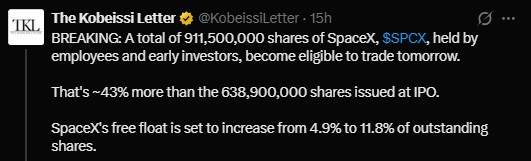
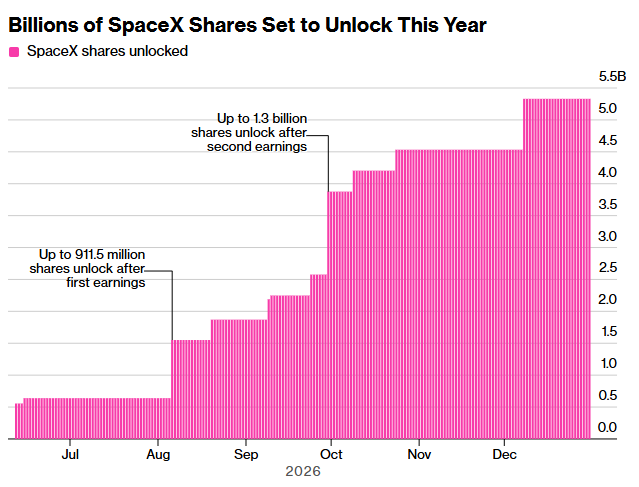
It's the first stage of a nine-stage lockup schedule, and analysts warn the added selling pressure could persist through December.
A second earnings-linked unlock could free up to 1.3 billion more shares, with roughly 12.9 billion additional shares scheduled to unlock by mid-2027.
Unlock Event | Shares Freed | Timing |
First earnings unlock | Up to 911.5M | Aug 6, 2026 |
Second earnings unlock | Up to 1.3B | Around Sept/Oct 2026 |
Remaining scheduled | Up to 12.9B | Through mid-2027 |
Where Does the Price Stand Right Now?
The SpaceX share price ($SPCX) closed at $125.12 on Tuesday, already under its $135 IPO price. By Wednesday afternoon it had slipped to around $108 to $109, close to its all-time low near $104, and far from June's peak above $225.
SpaceX Stock Technical Analysis: Key Levels
On the 1-hour chart, price broke above a descending channel that had capped it for weeks. Buyers pushed it up toward $126 before the rally stalled near the 200-hour moving average around $120 to $121.
Price has since pulled back to retest the $107 to $109 zone, the old channel's upper edge. Traders call this a breakout-and-retest, generally a healthy sign if the zone holds.
RSI has cooled to about 37, weak but not fully oversold. If buyers defend $107 to $109, upside targets are $115, then $120, and $125 to $126.
A failed defense opens the door to $104, then $100, with $90 and $85 as deeper downside levels some traders are watching.
What Are Analysts Saying?
JPMorgan raised its target to $240 from $225, with analyst Doug Anmuth citing SpaceX's fast-growing revenue run rate, which Musk said could hit $100 billion by year-end.
Anmuth sees SpaceX's AI revenue itself reaching $100 billion by 2027 if infrastructure monetization keeps up, but also flagged capex near $200 billion in both 2027 and 2028.
Part of the bet is that SpaceX becomes an alternative cloud player, renting out Nvidia-powered computing capacity even though its own AI models are seen as trailing OpenAI and Anthropic.
Wells Fargo cut its target to $215 from $230 over AI spending pace. XTB's Kathleen Brooks said the core worry is spending growth outrunning revenue growth.
CFO Bret Johnsen said the company is seeing "less than a one-year payback" on some AI compute. Musk moved his $1 trillion annual revenue target up to 2030 from 2031.
Other Numbers Worth Knowing
Starlink now counts 12 million subscribers. SpaceX still holds all 18,712 bitcoin on its balance sheet, worth about $1.1 billion at quarter-end.
The company also unveiled Starmind AI-1, an orbital AI payload built with Nvidia's Rubin GPUs and Vera CPUs, set to raise satellite computing capacity to 250 kilowatts, with Nvidia named as exclusive chip supplier.
SpaceX Stock Price Prediction: What's Next For SPCX?
A confirmed break below $100 on heavy volume would suggest unlock supply is overwhelming demand, opening a path toward $90 and $85.
If institutional buyers absorb the new supply instead, that could mark a shift toward longer-term accumulation, closer to the $215 to $240 analyst range.
No one can say for sure which path plays out. The next few sessions, especially how the market handles Thursday's unlock, should offer clearer signals.
Disclaimer:
This article is for informational purposes only and does not constitute investment, financial, or trading advice.Past performance does not guarantee future results. Always do your own research before making investment decisions.