Sible Network Q2 2027 Roadmap: Nexus, Cortex and Revenue Goals


Sible Network Q2 2027 Roadmap: What Will the New Phase Deliver?
Many AI projects promise a lot and explain little. Sible Network’s plan for the second quarter of 2027 is more specific: two named products, a partnership goal and a revenue target. This guide walks through the Sible Network Q2 2027 roadmap, using the official roadmap and product pages, and it separates what the project has published from what it has only planned.
Key Takeaways
Q2 2027 is called Enterprise AI Expansion. It plans to launch Sible Nexus and Sible Cortex.
Both products are built for private deployment, so data stays inside an organization’s security perimeter.
The $500M contracted-revenue target and the partnership goals are plans. No named contracts have been published.
What Is Sible Network?
Sible Network calls itself “the operating system for the AI world.” It unifies scattered data, runs AI models inside an organization’s own network and turns analysis into action. Its core products are Sentinel, Fabric and Cortex, with Nexus as an optional layer.
A community side runs next to it. Miners contribute GPUs to train and run models, and organizations pay SIBLE to use that capacity.
Source: official website.
Sible Network Q2 2027 Roadmap at a Glance
The roadmap lists four goals for the quarter.
Goal | What the roadmap says |
Sible Nexus | An AI operating layer for enterprise and government deployments |
Sible Cortex | Run LLMs and build AI agents and automations on private infrastructure, with full control and reliability monitoring |
Partnerships | Expand enterprise and public-sector partnerships across multiple markets |
Revenue | Scale commercial AI deployments toward a $500M contracted-revenue target |
Sible Network Q2 2027 Timeline
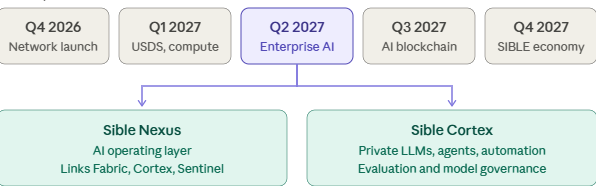
The quarter sits in the middle of a five-stage plan. Each stage builds on the one before.
Period | Theme |
Q4 2026 | Network launch and community economy |
Q1 2027 | Stablecoin, AI infrastructure and compute |
Q2 2027 | Enterprise AI Expansion |
Q3 2027 | Sible AI Blockchain and migration |
Q4 2027 | Global liquidity and SIBLE economy |
Source: official roadmap.
The roadmap gives only quarters, not exact dates, so every item is a target.
Sible Nexus: The AI Operating Layer
Nexus is described as optional. The homepage says each product runs on its own, but when a team wants Fabric, Cortex and Sentinel to behave as one system, Nexus is the shared layer that links them.
It does this by giving them a common language of real-world objects and actions. In plain terms, instead of working with raw tables, the AI can reason about things like a patient, a shipment or a machine. The roadmap pitches it for enterprise and government deployments, which makes it an AI operating layer for those users.
Sible Cortex: Private LLMs, Agents and Automation
Cortex is the AI platform. Its product page says it runs models inside an organization’s own security perimeter, so sensitive data does not leak out.
Capability | What it does |
Private deployment | Runs open-source, self-hosted or commercial LLMs on the organization’s network |
Agents and functions | Builds AI agents and LLM-powered functions tied to workflows |
Automation | Triggers processes from real events |
Evaluation suites | Measures accuracy, hallucination and drift |
Model governance | Access control, prompt logging and audit trails |
Object-aware mode | Reasons over business objects when connected to Nexus |
The page describes four steps from prompt to action:
Connect the models behind one governed gateway.
Ground them on the organization’s own data.
Build agents and run evaluation suites.
Deploy with logging, access control and human review where needed.
Private Infrastructure and the Security Perimeter
This is the idea that ties both products together. Sible says every model runs inside the organization’s security perimeter, and every access is permissioned, encrypted and fully logged.
The site lists private deployment on-premise or in a private cloud, role-based access down to each data object, and a complete history of every AI operation. A related product, Sible Relay, delivers updates to cloud, on-premise and air-gapped environments, with health checks and instant rollback.
On compute, the Cortex page says models can run on an organization’s own hardware or, optionally, on a decentralized GPU network called SCAI. That optional link is where the mining community fits in.
Nexus vs Cortex: How They Differ
Sible Nexus | Sible Cortex | |
Role | Shared layer for objects and actions | AI platform for models and agents |
Works alone? | Meant to connect other products | Yes, on existing data |
Needs the other? | No | No |
Main benefit | One system across products | Governed, private AI |
Neither requires the other. Used together, Cortex becomes object-aware.
Enterprise and Government Deployments: Where the Products Fit
The homepage lists six use cases, which show what the quarter’s products are aimed at.
Sector | Use case |
Finance | Fraud detection from transactions and risk signals |
Healthcare | Resource orchestration for beds, medication and staffing |
Manufacturing | Predictive maintenance from sensor data |
Energy | Grid optimization and anomaly detection |
Supply chain | End-to-end visibility |
Public sector | Situational response using multi-source intelligence |
These are examples from the project, not announced customers.
Sible Network Enterprise AI Expansion and the $500M Target
The last goal is a $500M contracted-revenue target. Contracted revenue means signed deals, not money already earned. Sible has published no contract totals, so the figure is a goal.
Sible Network Public-Sector Partnerships: What Is Claimed
The Sible Network roadmap aims to expand enterprise and public-sector partnerships across multiple markets. The homepage says “Trusted by 1000+ partners” and shows logos for Nvidia, SIPG, Public Health England and Changi.
No case studies or contract details sit next to them. Those logos are the project’s own claim, and the quarter’s partnership goal depends on turning such relationships into signed work.
How Q2 Builds on Q1
Q1 2027 plans a stablecoin called USDS, a data platform called Fabric, an AI marketplace and a developer platform. Q2 products lean on that base. Cortex grounds models on data, which is Fabric’s job, and Nexus links the products together.
One detail needs care. The Fabric product page describes itself as a demo concept inspired by Palantir Foundry, built as a design sample. The Cortex page says it is inspired by Palantir AIP. Readers should check how each product is presented before assuming it is live.
What Is Confirmed and What Is Not
Item | Status |
Nexus and Cortex launch in Q2 2027 | Planned, per the roadmap |
Product descriptions and features | Published on the website |
Exact launch dates | Not published |
Named enterprise or government contracts | Not published |
$500M contracted revenue | A target |
Risks and Open Questions
Launch dates are quarters only, and they can move.
The Fabric page’s demo-concept note raises a question about product readiness.
Partnership logos are unverified claims.
The revenue target has no published contract support yet.
Pricing, supported markets and customer names are not listed.
What to Watch Next
Product pages with launch status and release notes.
Named customers or case studies.
Public-sector announcements with real details.
Progress on the Q1 pieces, because Q2 depends on them.
Conclusion
The Sible Network Q2 2027 roadmap is clear about its goals: launch Nexus and Cortex, grow partnerships and scale commercial deployments. The security-perimeter idea is the strongest thread, since it speaks to what organizations worry about most with AI.
The proof is still ahead. Dates are quarters, partners are unnamed and revenue is a target. Readers should follow the official roadmap and judge the quarter by what actually ships.
Disclaimer: This article is for information only and is not financial, investment, or legal advice. Facts come from the official Sible Network website, roadmap and product pages, as seen in November 2026. Plans and dates may change. Crypto carries real risks, including loss of funds. Readers should do their own research before acting.