SwarmOracle Explained: How SwarmBase Is Building Verifiable AI

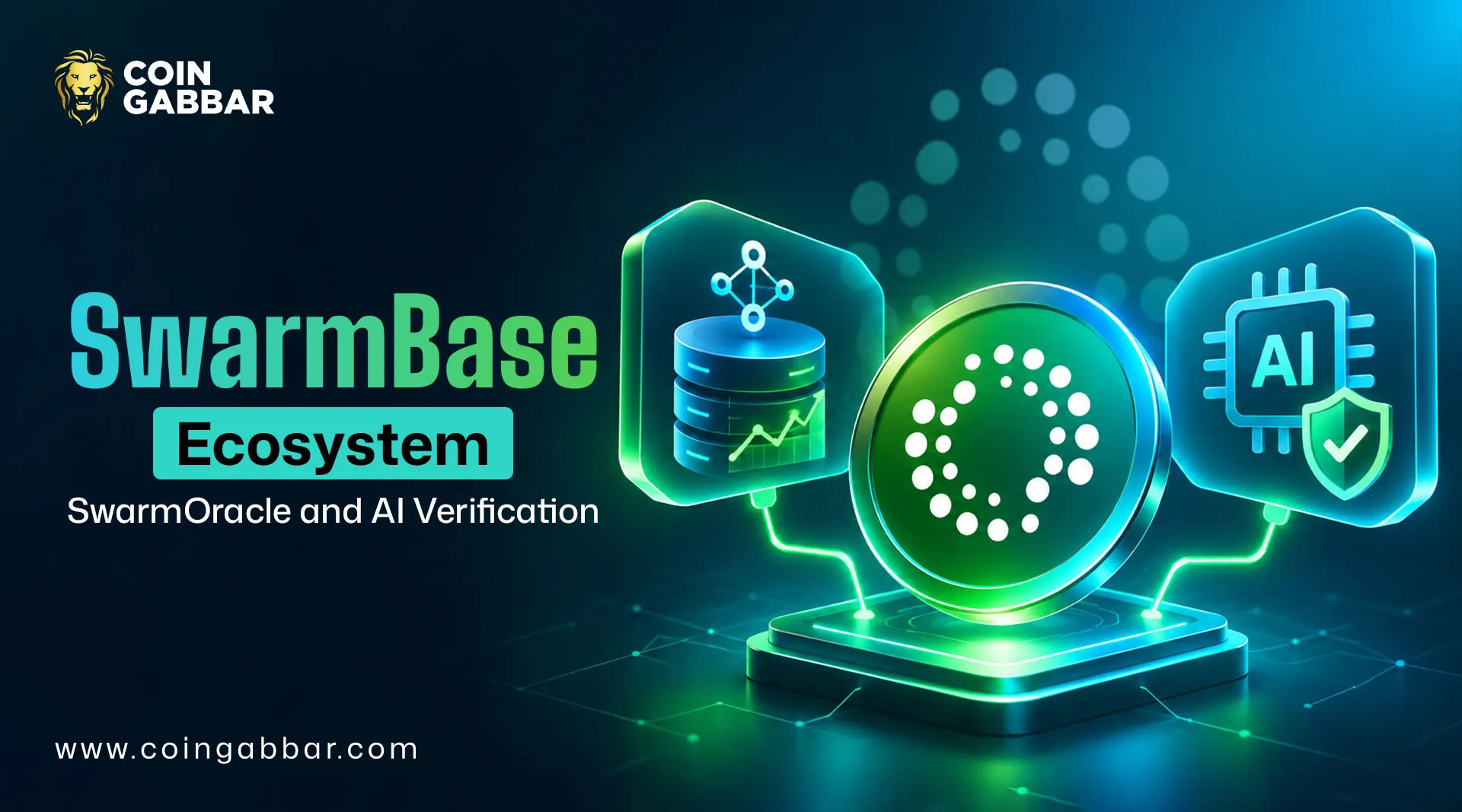
What Is SwarmOracle and How Does It Work Within SwarmBase?
AI answers arrive in seconds, but checking them takes much longer. Anyone who has used a chatbot for research knows the routine: read the answer, then open five tabs to see if it holds up.
SwarmOracle is SwarmBase’s attempt to shorten that second step. This SwarmOracle explained guide covers what the team announced, how it fits into the wider project, and which details are still missing.
The facts come from the SwarmBase announcement on X and the official website and whitepaper.
Key Takeaways
The goal is checkable answers. SwarmOracle pulls live data, runs software, tests its own conclusion, and writes the result on chain.
It builds on existing SwarmBase work. The announcement calls it an extension of the agent swarm and verification technology, such as Proof of Swarm.
Verification is still evolving. The exact proof method, public launch date, access details, and supported use cases have not yet been disclosed.
What Is SwarmBase?
SwarmBase is decentralized infrastructure for deploying and coordinating autonomous AI agent swarms. Its site says a swarm can scale from 10 agents to 10,000, with 50ms latency inside the swarm.
The project token is $SWARM, a BEP-20 token on BNB Smart Chain with a fixed supply of 1 billion.
Source: official website.
Pillar | What it does |
SwarmCore | Splits tasks and assigns agents |
ComputeMesh | Connects GPU providers in a peer-to-peer market |
HiveMind | Lets agents share memory and context |
Proof of Swarm | Verifies what agents produce |
SwarmBase SDK | Gives developers tools to build and deploy |
SwarmBase SwarmOracle: The Announcement
SwarmBase introduced SwarmOracle as a way to open up the black box of AI research. The team’s label for the idea is Swarm Oracle verifiable intelligence, meaning an answer that shows its work instead of asking for trust.
Three promises sit at the center of the pitch. Research should not need a second round of manual checking. Conclusions should be solid enough to act on. Machines should answer for the claims they make.
The team also argues that verified intelligence is worth more than the unverified kind, and it describes the launch as the start of that shift. That is the project’s own view. It is a forecast, not a measured result.
Idea in the announcement | Meaning |
Reaches into the real world | Uses live data, not only old training data |
Interrogates its own conclusion | Tests an answer before publishing it |
Proof fused to the answer | Evidence is stored with the result |
Repricing of intelligence | Verified answers valued above unverified ones (the team’s view) |
What Is SwarmOracle?
It is a system built to turn AI conclusions into records that can be audited. Summaries of the launch describe fused proofs that give outputs tamper-resistant accountability.
Think of it as an AI researcher that must show its receipts. The receipts live on a blockchain, not in a private log.
What Is Verifiable Intelligence?
Verifiable intelligence is an answer that comes with evidence of how it was produced. The reader does not have to take the conclusion on faith.
Typical AI answer | Verifiable intelligence | |
Sources | Often unclear | Pulled live and recorded |
Checking | Done by the reader | Built into the process |
Record | Chat history | On-chain entry |
Accountability | Rarely any | Stated as a core aim |
The AI Trust Gap
Language models can sound sure while being wrong. That is the AI trust gap, and it gets expensive when an answer feeds a financial or automated decision.
SwarmBase names a similar problem on its own site. It lists a trust deficit and says no production-grade protocol exists for verifying agent outputs. That is the project’s claim, not an industry fact.
The wider field of verifiable AI tries to close this gap with proofs rather than promises. The announcement places Swarm Oracle in that effort.
How Does SwarmOracle Work?
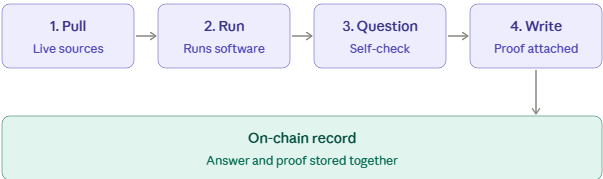
Based on the official announcement, the process runs in four stages.
Stage | Action |
1. Pull | Gathers live sources from the real world |
2. Run | Executes software on that data |
3. Question | Interrogates its own conclusion |
4. Write | Records the answer on chain with proof attached |
The sources reviewed do not explain which proof method sits behind stage four. Treat that part as unconfirmed.
SwarmOracle On-Chain Proof
Writing a result on chain gives it a public, timestamped home. Records there are generally hard to change after the fact.
The announcement says the proof is fused to the answer. In plain terms, the conclusion and its evidence travel together. A reader never gets one without the other.
SwarmOracle and SwarmBase Agent Swarms
The project describes SwarmOracle as an extension of its autonomous agent swarms. Swarms, per the official whitepaper, are coordinated groups of specialized agents that pass work along a chain of tasks.
Agents produce a lot of conclusions. A layer that checks them fits the same stack, which is likely why SwarmBase framed the launch this way.
SwarmOracle and Proof of Swarm
Proof of Swarm is the whitepaper’s verification system. Agents complete inference tasks and send out a bundle of results and attestations. A task finalizes once validators holding two-thirds of the stake approve it.
Validators stake $SWARM as collateral, and dishonest ones lose part of it.
Violation | Penalty |
Downtime over 3 epochs | 1% of stake |
False attestation | 5% of stake |
Double attestation | 10% of stake |
Proof fabrication | 100% of stake |
The whitepaper marks this system as a later-phase feature. The official Swarmbase roadmap places the validator vault in Q4 2026, hardware attestation in Q1 2027, and full zero-knowledge proofs in 2027 and beyond. How it will connect to each piece is not spelled out.
SwarmOracle vs Traditional Blockchain Oracles
A traditional oracle brings outside data, such as a price, to a smart contract. SwarmOracle, as announced, aims further. It produces a conclusion and attaches proof, not just a number.
Traditional oracle | SwarmOracle (as announced) | |
Main job | Relay external data | Reach, test and verify conclusions |
Output | A data point | An answer with fused proof |
Reasoning step | Usually none | Interrogates its own conclusion |
Stated focus | Data delivery | Accountability for claims |
This is a comparison of design goals, not performance. No independent test results have been published in the sources reviewed.
What Is Still Unknown
Confirmed in sources | Not yet public |
Live sources, software, self-check, on-chain write | Exact proof method |
Described as an extension of swarm tech | Launch status and access |
Links to Proof of Swarm themes | Supported use cases |
Final Thoughts
SwarmOracle targets a real problem, which is trust in machine-made answers. The idea is clear, and the link to SwarmBase’s swarm and verification work makes sense.
The details are still thin, though. Readers should wait for documentation before drawing conclusions, and check the official pages first.
Disclaimer: This article is for information only and is not financial advice. The SwarmBase whitepaper itself says $SWARM may lose value in part or in full. Always do your own research.