Tokenized Securities 101: What DTCC's $30T Plan Really Means

Why Are Stocks and Bonds Moving Onto Blockchains Now?
Tokenized Securities 101 starts with a simple question that many readers ask. What happens when a company share or a government bond turns into a digital token on a blockchain? The question got louder after the Depository Trust and Clearing Corporation (DTCC), the company that handles settlement for most US securities, shared a plan to tokenize assets worth about $30 trillion.
This guide covers the basics, the main features, how the process works, and the risks worth knowing. Research for this article ended on October 26, 2026.
What Are Tokenized Securities and How Do They Work?
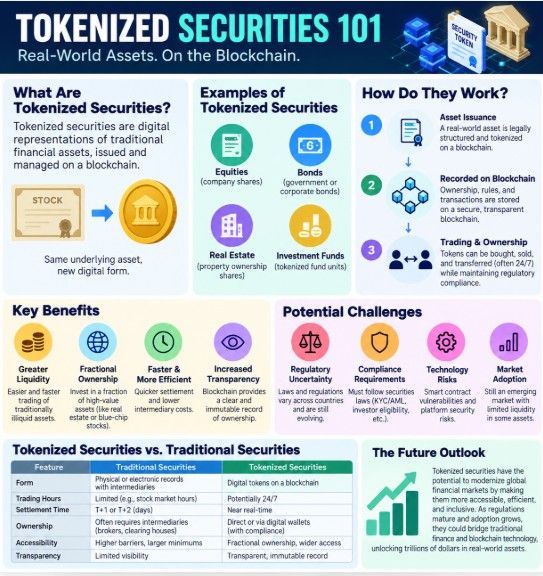
Tokenized securities are everyday financial products, like stocks, bonds, and fund shares, that live on a blockchain or a similar shared ledger as digital tokens. The US Securities and Exchange Commission calls them digital securities, and its March 2026 guidance says they stay securities under federal law, with full investor protections.
A blockchain is a shared digital record book. Many computers keep the same copy, so nobody can quietly change old entries. Each token on that record points to a real asset, like a company share, that a person owns.
The process usually has four steps. Issuers pick an asset, set up a legal structure that follows securities rules, create the token on an approved blockchain, and let holders trade it on platforms that check compliance.
Which Models Does Tokenized Securities 101 Cover Today?
SEC staff describes three models, and the differences matter more than the names. In an issuer-sponsored model, the company puts the security straight on a blockchain, so voting, dividend, and ownership rights match a normal share of that class.
A custodial model works differently. The token stands for an indirect claim on a security that a middleman holds, much like owning shares through a broker. Synthetic models are weaker for holders because they only follow a price and give no claim against the original issuer.
Tokenized stocks and tokenized equity usually mean company shares in digital form, while a tokenized bond is government or corporate debt that pays interest on a schedule. Fund shares work the same way, including money market and real estate funds.
What Features Make Tokenization Attractive to Institutions?
Faster settlement tops the list, because a blockchain transfer can finish in minutes, while US stock trades usually settle the next business day. Tokenized Securities 101 also covers round-the-clock transfers, fractional ownership, and programmable rules.
Programmable means a smart contract, which is a self-running computer program on a blockchain, can enforce transfer limits or pay interest without manual work. Transparency improves too, since a shared ledger gives every approved participant the same clear record of ownership.
Liquidity, meaning how easily holders can sell without moving the price, may get better. But that depends on how many buyers and sellers actually show up.
What Does the DTCC $30T Plan Actually Include?
The Depository Trust Company (DTC), a DTCC subsidiary, holds more than $114 trillion in securities. SEC staff sent DTC a no-action letter on December 11, 2025, which allows a small three-year pilot starting in the second half of 2026.
A no-action letter means regulators will not push enforcement if the program runs as described, and it ends three years after launch. It isn’t a law, and it isn’t a permanent approval.
Published reports say the first phase covers 25 securities, including Russell 1000 stocks, some exchange-traded funds, and US Treasuries, with assets held at DTC worth roughly $30 trillion. That number shows the pool of assets open to tokenization, not money already on-chain.
Each token reportedly matches the real security one to one, uses the same CUSIP, the standard ID number for a US security, and keeps the same rights, while DTC holds the official ownership record. Transfers between registered wallets can run around the clock, with compliance limits attached.
Reports point to a limited phase in July 2026 and a full launch due in October 2026. Official pages checked for this article haven’t confirmed an exact start date, so that detail stays unverified.
How Do Tokenized Market Makers and Tokenized Deposits Fit In?
A tokenized market maker is generally a trading firm that quotes buy and sell prices for digital securities, which keeps tokenized stocks tradable when regular stock exchanges are closed. Without that activity, round-the-clock trading could turn thin, and prices could swing sharply.
A tokenized deposit is a different tool. It’s a bank deposit turned into a token, so it remains a claim on the bank and differs from a stablecoin, a token pegged to a currency.
In the DTCC design, reports say Treasury interest and maturity payments still go to traditional bank accounts in regular currency. Tokenized deposits could later work as the cash side of on-chain trades, though no official plan confirms that yet.
Which Risks Does Tokenized Securities 101 Involve?
Rules are still changing, and while the SEC says tokenized securities are securities, laws differ by country, and some industry firms have asked regulators to wait for more detail on how settlement will work.
Technology brings its own risks, since smart contract bugs, wallet mistakes, and custody failures can cause losses that old paper systems rarely faced. And a synthetic product can leave holders with price exposure but no legal claim, which surprises many first-time buyers.
Adoption is early, since industry trackers put tokenized real-world assets at more than $33 billion, which is small beside the $114 trillion held at DTC.
What Does the Data Say About the DTCC Plan?
The stronger sign is that established market firms, not crypto startups, lead this first phase, which lowers legal doubt for the whole Tokenized Securities 101 category. At first the $30 trillion figure sounded like marketing, but the one-to-one token setup and the three-year regulatory framework point to a careful and slow build.
The main concern is that headline numbers can mislead, because $30 trillion measures eligible assets rather than real demand. Another unknown is how many institutions will join the pilot and how quickly wallets, sign-ups, and approved networks will grow. Readers should verify launch dates, eligible securities, and investor protections directly in official filings before drawing conclusions.
Final Takeaway on Tokenized Securities 101
Tokenization could update market settlement, yet the DTCC pilot remains limited, and the next official launch update will show whether the $30 trillion figure becomes real activity.
Disclaimer
This article is for informational purposes only and isn’t financial, legal, or investment advice. Tokenized assets carry high risk, so readers should research independently and consult a licensed professional before making any decision.
















