Wire Network Ecosystem: Liquidity Strategy, Nodes and Future Plans

How Does the Wire Network Ecosystem Support Cross-Chain Transactions?
Most blockchain projects launch a token first and look for a purpose later. Wire Network is trying the reverse order. It is building a shared transaction layer and raising liquidity for it before mainnet goes live. This guide maps the Wire Network Ecosystem in plain words: what exists, what is still ahead and who is backing it.
Key Takeaways
Wire Network is building a Universal Transaction Layer where assets stay on their own chains and only ownership moves.
Its liquidity-first approach sends all LCO proceeds into protocol-owned liquidity before mainnet.
Most of the roadmap is still ahead, and launch dates have shifted before, so every plan here can change.
What Is Wire Network?
Wire Network calls itself the first Universal Transaction Layer, or UTL. Its GitHub documentation says the UTL lets all crypto assets and wallets use smart contracts on one blockchain.
It is a blockchain project and has no link to the messaging app with the same name.
Source: official website.
What Is the Wire Network Ecosystem?
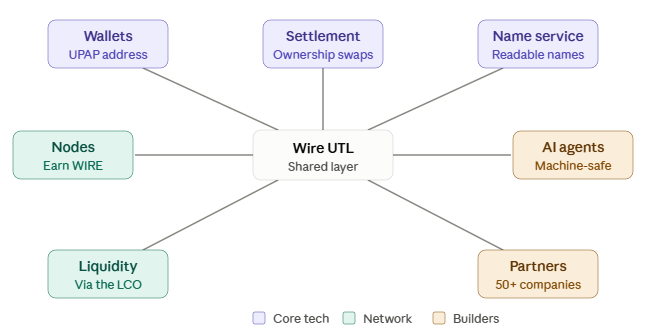
It is the set of parts that grow around that one layer: the chain, wallets, names, nodes, liquidity, builders and backers.
Think of the Universal Transaction Layer ecosystem as a hub. Apps connect once, and users bring the wallets they already own.
Why Wire Takes This Route
Two problems shape the whole plan.
The first is fragile liquidity. Many tokens debut with thin markets, and speculation then bends the price. The second is bridges. Reports describe cross-chain bridges as a repeated weak point for security and reliability.
Wire answers the first with the LCO and the second with ownership swaps on its own layer. Most of the ecosystem grows from those two choices.
How Does the Wire Network Ecosystem Work?
A user starts with an existing wallet. The Universal Polymorphic Address Protocol (UPAP) derives a Wire address from it, so no new wallet is needed.
Assets stay locked on their native chain. Only ownership rights are swapped on Wire’s Settlement Layer, and readable names replace long addresses.
Core Building Blocks
Part | Role |
Settlement Layer | Base chain where ownership rights change hands |
UPAP | Derives a Wire address from an existing wallet |
Name service | Turns external addresses into readable names |
Universal Wallet | One access point, with Crypto Single Sign-On |
Nodes | Secure the network and earn WIRE rewards |
The Wire Network Universal Wallet is meant to simplify access, so users do not juggle a new wallet for every chain.
Wire Network Liquidity Creation Offering: A Liquidity-First Launch
The Wire Network Liquidity Creation Offering, or LCO, is the project’s answer to fragile token launches.
Wire Network LCO explained in short: according to The Defiant, it is the sole path to WIRE before the token generation event. Participants stake ETH or SOL and earn WIRE pre-tokens at pre-launch pricing, while keeping ownership of what they staked.
Staking rewards and pre-token proceeds flow into protocol-owned liquidity. That is the Wire Network liquidity-first launch idea. The team says the proceeds do not fund company operations, and it also says the LCO is not a yield product.
Wire Network Mainnet: What Comes Next
The Wire Network mainnet depends on liquidity, not on a calendar. Once the liquidity threshold for full operations is met, the network moves to mainnet. Pre-tokens then convert one to one into native WIRE, and the first products built on the UTL follow the token generation event.
Dates have moved before. The team called the latest shift a strategic decision, not a technical delay.
Nodes and Early Support
Node ownership sits at the centre of the design. Reports say each node adds to security and earns WIRE rewards, and may later earn revenue by selling compute as demand grows.
When the LCO was announced, the company said it was nearing $20 million in combined equity and node sales.
Wire Network Ecosystem Partners and Backers
More than 50 companies have committed to building on Wire, according to the January announcement. These Wire Network partners and backers were named at that time:
Name | Type |
Yuga Labs | Named partner |
Red Beard Ventures | Named backer |
Prota Ventures | Named backer |
GDA Capital | Named backer |
Michael Terpin | Industry figure aligned with the project |
Ken DiCross (CEO), Jaime Rogozinski (Chief Strategy Officer) and Jon Glanz (Chief Product Officer) lead the team.
Who Does What in the Ecosystem
Each group has its own job, and the documents and reports describe four.
Role | What they do |
Everyday user | Brings an existing wallet and uses Wire apps without making a new one |
LCO participant | Stakes ETH or SOL and earns WIRE pre-tokens |
Node owner | Helps secure the network and earns WIRE rewards |
Builder | Integrates once with the UTL instead of chain by chain |
How each role works in practice will be clearer once mainnet is live.
The AI Agent Economy Angle
Wire also positions itself for the AI agent economy. Applications integrate once with the UTL instead of rebuilding coordination logic for every chain. CEO Ken DiCross describes the goal as machine-safe execution with explicit outcomes. That is a stated aim, not a proven use.
Open Code and a Privacy Rule
Builders can inspect the work. The documentation repository links to the core node software, system contracts, SDKs and a block explorer, plus a testnet demo.
It also sets one privacy rule. No personally identifying information goes on-chain, except data needed for council nominations.
Roadmap Snapshot
Stage | Status |
UPAP launch announced | June 2022 |
LCO announced | January 2026 |
Testnet demo | Listed in the documentation |
TGE | Planned for the second half of November |
Mainnet | After the liquidity threshold, no fixed date |
First UTL products | After the TGE |
What to Keep in Mind
Most details here come from the project, its documents and press coverage. Pre-token participation carries risk, so reading the terms on the official LCO hub matters. Plans and dates can change, and the safest place to confirm them is the official channels.
Final Thoughts
The Wire Network Ecosystem is easiest to read as a build order: shared layer first, liquidity second, mainnet third, products after that. The ideas are clear on paper, and the backers are named. The proof will come once mainnet and the first UTL products go live. Until then, the practical habit is to follow official channels and judge the project by what ships.
Disclaimer: This article is for information only and is not financial, investment or legal advice. Crypto involves real risk, including loss of funds. Facts come from the project’s documentation, press releases and public reports as of the date of writing. Plans and dates may change, so please verify everything on the official website.