Zebec Network Governance: Exploring DAO Rules and ZBCN Voting


What Makes Zebec Network Governance Different From Other DAOs?
Most crypto projects talk about community power. Few explain how a proposal actually becomes a decision. Zebec Network governance works through a hybrid model. Discussion happens off-chain first, and the binding vote happens on-chain.
This guide covers how Zebec DAO voting works, what a ZIP is, and what ZBCN holders should know before they take part.
Key Takeaways
Zebec runs a hybrid governance model, so ideas are tested in open discussion before any on-chain vote.
A proposal needs a quorum of 33% of circulation, and the ZIP voting period runs from 24 hours to 7 days.
ZBCN is both the governance token and the utility token, so voting power sits with the people who hold it.
What Is Zebec Network?
Zebec Network is a payment and payroll project that moves money in real time. Employees can be paid by the second in stablecoins, and users can spend crypto through multi-chain debit cards.
Source: official website.
The team has been building decentralized infrastructure since 2021. The official site lists the following numbers.
Metric | Figure |
Annual payroll volume | $500M |
Enterprise clients | 250+ |
Monthly users (on- and off-chain) | 50K+ |
Chains integrated | 20+ |
Tokens integrated | 150+ |
A network handling this much payroll needs clear rules for who decides what. That is the job of the Zebec DAO.
What Does the ZBCN Governance Token Do?
The ZBCN governance token gives holders a say in the direction of the network. Influence is proportional to the amount of ZBCN a person holds or controls.
Voting is only one part of ZBCN token utility. The same token is used in several other ways:
Payroll and product fees: Institutional clients can pay service fees in ZBCN.
Staking: Staking is available with rewards of up to 15% APY.
Card rewards: Zebec Card users can earn up to 5% ZBCN cashback.
Fee reductions and VIP tiers: Holding and staking ZBCN unlocks added benefits.
Because the token is used for real payments, voters have a direct stake in how the network runs.
How Does Zebec Hybrid Governance Work, On-Chain and Off-Chain?
Zebec hybrid governance on-chain and off-chain splits a decision into two stages. Neither stage replaces the other.
Stage one is off-chain consultation. Community members, investors and partners raise ideas on Zebec’s forums and social channels. Weak ideas fade here, before anyone spends votes on them.
Stage two is on-chain voting. Proposals that gain traction and informal agreement move to a formal vote. Results are recorded on-chain and shared publicly, and approved proposals move to execution.
This is why the model is called hybrid rather than purely on-chain. A full on-chain DAO votes on everything. Zebec filters first, then votes.
What Is a ZIP in Zebec Network?
ZIP stands for Zebec Improvement Proposal. It is the formal document a proposer submits to change something in the network.
ZIPs cover topics such as treasury management, new business initiatives, operational upgrades and setting priorities. Every DAO proposal that reaches a vote follows the same path through the governance hub.
A ZIP also has a written description, clear voting options and a visible tally. Anyone can check them before deciding how to vote.
Source: official documentation.
How Does Zebec DAO Voting Work?
Zebec DAO voting runs on Solana Governance Realms. The DAO moved there in September 2024 after earlier operating on Binance, because the team wanted a simpler setup for a Solana-native token.
Here are the main rules in one place.
Rule | Detail |
Governance token | ZBCN |
Minimum to create a proposal | 0.5% of ZBCN |
Minimum to vote | Stake of 5% of ZBCN token held |
Quorum | 33% of circulation |
ZIP voting period | 24 hours to 7 days |
Passing rule | Simple majority |
Execution | Triggered on-chain where applicable |
Voting power depends on how much ZBCN a holder commits. A larger stake carries more weight.
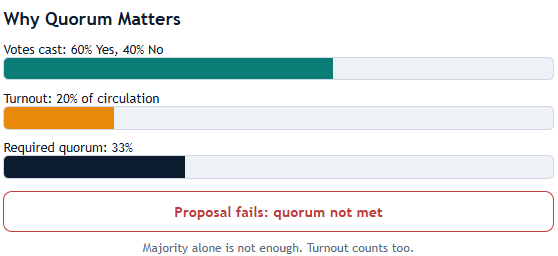
The quorum matters just as much as the majority. A proposal can have more yes votes than no votes and still fail if turnout stays below the ZBCN quorum of 33% of circulation.
Where Can ZBCN Holders Vote?
The governance hub lives at dao.zebec.io. Users connect a crypto wallet to see active proposals, ended proposals, voter lists and vote totals.
Each proposal page shows the description, the start date and the for and against count. A holder casts a yes or no vote using ZBCN.
Anyone can open the New Proposal page to submit a DAO proposal, provided they meet the 0.5% requirement.
What Has the Zebec DAO Already Decided?
The track record shows the process in action. Four proposals, ZIP-1 to ZIP-4, reached a vote over roughly 18 months after consultation with investors and large holders.
ZIP-4 aimed to redirect future protocol and card revenues toward platform growth. It was approved in January 2024 with 90.52% of over 200 votes.
It also reshaped the Zebec tokenomics by pausing the token burn while keeping recurring buybacks. The DAO later approved the buyback program by vote in late 2024.
A 2025 roadmap vote also took place on Solana Realms.
Strengths and Challenges of the Model
Advantages
Filtered proposals: Off-chain consultation removes weak ideas early, so on-chain votes stay focused.
Public records: Voting history and proposal details sit on-chain, so anyone can check them.
Quorum protection: The 33% threshold stops a tiny group from passing changes alone.
Challenges
Weight follows holdings: Larger holders carry more voting power than small ones.
Turnout risk: Reaching 33% of circulation is hard when many holders stay passive.
Informal first stage: Off-chain talks have no fixed rulebook, so outcomes depend on who joins the discussion.
Conclusion
Zebec Network Governance gives ZBCN holders a structured way to influence the network's future through community discussions and on-chain voting. Its hybrid model allows proposals to be reviewed before reaching a formal DAO vote, while quorum and voting requirements provide a framework for decision-making.
However, the model's effectiveness depends on active participation, transparent discussions and consistent voter turnout. As Zebec expands its payment and payroll ecosystem, future ZIP proposals will show how effectively the decentralized autonomous organization balances community interests with long-term network growth.
Disclaimer: This article is for informational purposes only and is not financial advice. Crypto assets carry risk, and you may lose funds. Governance rules can change through DAO votes, so check the official site and governance hub before acting.