Zenora Exchange Explained: Spot Trading and ZNR Liquidity

How Will Zenora Exchange Manage Trading, Liquidity and Settlement?
Every new token eventually faces the same question: where will people trade it? For Zenora, the answer is Zenora Exchange, a first-party venue that exists only as a preview today. The project describes it as a spot market for ZNR and other assets on the network, with real order books and settlement tied to the chain.
This guide explains that design as the project presents it, and it keeps what is planned apart from what is running. The preview carries a coming-soon label and sample data, so no market is live yet. A plan is not a market, and the difference matters.
Key Takeaways
The exchange is a preview with sample data only, and no live market exists yet.
It is designed around spot markets, network-seeded liquidity, custody choice, chain-based settlement and fees that return to the ecosystem.
Total supply is fixed at 1 billion, and 7% is set aside as day-one liquidity.
Zenora Network in Brief
Zenora Network is an EVM compatible Layer-1 built with Polygon CDK. The official website describes it as built in the open, one stage at a time, across five roadmap stages. The community app came first, and the chain follows. The whitepaper, a draft last revised in September 2026, states that no live chain exists yet.
Source: official website.
The $ZNR Token in Brief
The $ZNR token, also called Zenora Coin, is the network’s single native asset. It pays gas, bonds validators, carries governance weight, unlocks an optional app tier and settles dApp fees. Supply is fixed at 1,000,000,000, with no minting after genesis. According to the whitepaper, it has not launched and is not transferable, tradable or listed anywhere today.
What Is Zenora Exchange?
Zenora Exchange is a first-party trading venue planned for ZNR and, over time, other assets built on the network. It is separate from third-party listings, which would be independent exchanges choosing to list the token.
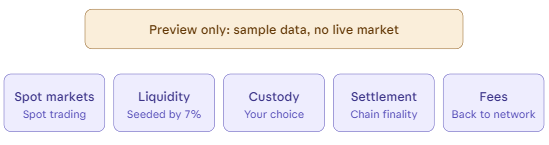
So how will it work? The exchange preview names five ideas:
Idea | What the preview says | Still open |
Spot markets | ZNR and network tokens trade against each other from day one | Which pairs will exist |
Liquidity | Seeded in part by the liquidity allocation | How deep the books will be |
Custody | Exchange-held balance or a self-custodial wallet | The final model |
Settlement | A trade settles when the chain says it does | The finality configuration |
Fees | Flow back into the ecosystem | The fee schedule |
The whitepaper adds that the exact model is not decided. It could be a conventional custodial exchange, an aggregator sitting in front of decentralized liquidity, or something else.
Where the Exchange Sits on the Roadmap
The roadmap has five stages, and each one carries a status instead of a date. The whitepaper places the exchange inside the wider ecosystem plan. It also mentions third-party exchange listings as a separate item in the fifth stage.
That leaves no launch date for the exchange in the official material.
Zenora Exchange Spot Markets Explained
A spot trade is a simple swap at the current price, with the asset changing hands right away. Futures differ, because the deal settles later.
Spot markets run on an order book. Buyers post bids and sellers post asks. The gap between the best bid and the best ask is the spread, and the total size of orders waiting at each price is the market depth. A thin book means a wide spread and larger price swings on small trades.
The preview shows a sample order book and a list of trading pairs. All of it is labeled illustrative, so none of those pairs or prices should be read as confirmed.
Centralized vs Decentralized Exchange: Where Zenora Fits
Centralized | Decentralized | |
Who holds funds | The operator | The user’s own wallet |
How trades match | The operator’s order book | Smart contracts and liquidity pools |
Main trade-off | Convenience for trust | Control for more responsibility |
Zenora has not picked a side yet. The whitepaper plans decentralized swaps and liquidity pools as a separate piece, so the exchange and the on-chain pools may end up covering both models.
Self-Custody vs Exchange-Held Balances
The design offers both. A user can trade with an exchange-held balance for convenience, or connect a self-custodial wallet for control. In a self-custodial wallet, the user alone holds the private keys, so nobody else can freeze or move the funds.
The whitepaper plans a native network wallet that is self-custodial by design. An early Zenora wallet already exists inside the community app. The trade-off is plain: an exchange-held balance means trusting the operator, so the custody terms deserve a careful read once they are published.
Zenora Exchange Liquidity Allocation Explained
A market with no orders is hard to use. To avoid that, the whitepaper sets aside 7% of supply, or 70,000,000 ZNR, as liquidity. It is the only category fully unlocked at the token generation event.
Category | Share of supply | Unlocked at launch |
Liquidity | 7% | 100% |
Community and airdrop | 20% | 25% |
Team | 15% | 0% |
Investors | 15% | 0% |
The percentages are settled, while the vesting terms are planning targets. The whitepaper also gives an initial circulating target of 250,000,000 ZNR, a figure the team sets because there is no live chain to read from. Seeded liquidity helps, but it does not guarantee deep books.
How Trades Settle on Zenora Network
The design says a trade settles when the chain finalizes it, instead of being recorded on a separate internal ledger. The whitepaper explains why: exchanges and bridges need one clear point at which a transaction is irreversible.
The consensus mechanism, block time and finality time are not published yet. They are due before the public testnet. Until then, no settlement speed claim can be checked.
The preview also says trading fees flow back into the ecosystem. The whitepaper does not assert a token burn or a fee buyback, so neither should be assumed.
Is ZNR Tradable on Zenora Exchange?
Not today. The site states that Zenora Coin is not yet listed or tradable, and the whitepaper says the same. Every price on the preview is sample data, and there is no live market.
Several things have to happen first: the token must launch, the chain must go live, and the exchange must become a working product. None of those steps has a published date.
Risks Worth Knowing
The whitepaper marks itself as a draft pending review. Its risk section covers technical, market and regulatory risks, and it states that nothing in it is a guarantee. A fixed supply and a seeded liquidity pool also do not promise any price.
What Careful Readers Check Before Trading Any New Token
Official links only, since lookalike sites are common around new launches.
Whether a displayed price is live or sample data.
The custody terms and the fee schedule, once they exist.
The unlock schedules, because they shape supply over time.
Final Thoughts
The plan for Zenora Exchange is clear, and the documents are honest about what is unfinished. Readers who keep plan and product separate will judge it more fairly when it arrives.
Disclaimer: This article is for information only and is not financial advice. Crypto assets carry risk, so research carefully before making any decision.












Frequently Asked Questions (FAQ)




