CIFORUS Roadmap 2026-2027: What Is Coming Next?

Where Does CIFORUS Stand, and What Comes Next?
Ciforus is a privacy-focused platform with encrypted email, wallet messaging, storage, notes and PayLinks. Its token, CIFORUS, is meant to add token utility to that app through discounts, tier upgrades and staking. So where is the project headed?
The CIFORUS Roadmap answers that, but it mixes two things. Some items already exist in the app. Others are targets with dates attached. This article walks through all six phases, checks what the official materials call complete and looks at what's planned through 2027.
What Is the CIFORUS Roadmap?
The CIFORUS Roadmap is the project's published development plan. It splits the work into six phases, from late 2024 to 2027. The first three cover designs, build, and launch. The last three cover growth, integrations, and scale.
The plan sits in the official roadmap section and in more detail in the whitepaper. It centers on privacy tools, token utility, and ecosystem growth. Anyone searching for the CIFORUS roadmap 2027 plans will find that the final phase is described only in broad terms.
One caution applies throughout. A roadmap is the project's own statement of intent. Dates are targets, not confirmed deliveries.
CIFORUS Roadmap 2026-2027: All Six Phases Explained
The phases below follow the project whitepaper, version 1.4 from March 2026, and the roadmap page.
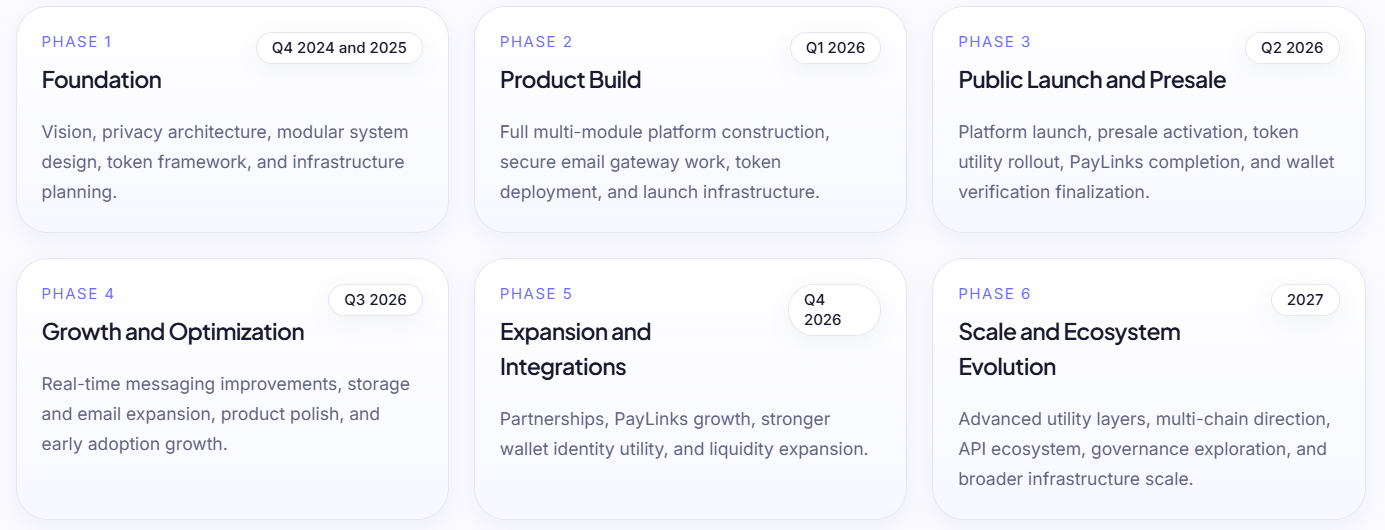
Phase 1: Foundation (Q4 2024 and 2025)
Vision and privacy-first architecture
Modular platform design
Infrastructure planning
A token framework, later detailed in the tokenomics breakdown
Phase 2: Product Build (Q1 2026)
Core platform development
Secure notes, storage, and messaging
Secure email gateway work
Token deployment and presale infrastructure
Phase 3: Public Launch and Presale (Q2 2026)
Public platform launch
Presale activation
First token utility
PayLinks and wallet verification
Phase 4: Growth and Optimization (Q3 2026)
Real-time messaging improvements
Storage and email expansion
Product polish and early user growth
Phase 5: Expansion and Integrations (Q4 2026)
Strategic partnerships
PayLinks growth and wallet identity upgrades
Liquidity expansion and exchange-listing efforts
Phase 6: Scale and Ecosystem Evolution (2027)
Advanced token utility
Multi-chain direction and an API ecosystem
Governance exploration
Automation, smart workflows and infrastructure scaling
Which CIFORUS Roadmap Milestones Are Already Complete?
Not every phase is marked done. The CIFORUS Roadmap page itself doesn't tick off any phase. The surrounding materials give more clues.
The token is deployed on Ethereum Mainnet as an ERC-20, and the official token page links its public contract. That one is verifiable by anyone.
The app is described as live. The page lists about 2,900 registered users and 199,800 private transfers on October 11, 2026. Those are project-reported figures.
The whitepaper marks PayLinks and wallet verification as done. It also lists notes, secure storage, wallet messaging, and the security dashboard as built. Staking is live and voluntary, and the claim and staking update covers how presale tokens can be kept or claimed.
Remember the March 2026 date on that whitepaper. A past target date isn't proof of delivery, so each milestone needs matching against current product functionality.
What Is CIFORUS Planning for the Rest of 2026?
Q3 2026 has now ended, which makes its items worth checking. The stated plan covered real-time messaging upgrades, wider storage and email features, and interface polish. The whitepaper adds privacy-respecting analytics. Messaging and storage are the easiest to verify, since users can test them directly.
Q4 2026 is the current phase. The stated plan includes partnerships, PayLinks growth, and stronger wallet identity across platforms. It also lists exchange-listing efforts and liquidity expansion.
All of this is planned unless proven otherwise. The whitepaper itself says an exchange listing isn't guaranteed. No partner or exchange names appear in the materials reviewed.
CIFORUS Roadmap 2027: What Comes Next?
The 2027 phase is the least detailed. It reads as a direction, not a schedule.
Multi-Chain Expansion
The project states a "multi-chain direction." Today the token lives only on Ethereum. No second network is named. More chains would also mean new contracts and bridges, which bring their own security questions.
API and Developer Ecosystem
Plans mention an API layer and developer tools. That could let outside apps connect to Ciforus. No public developer documentation turned up in the reviewed materials.
Advanced Utility and Governance
Phase 6 lists advanced token utility layers and governance exploration. The whitepaper calls governance a later-phase extension, not a launch feature. "Exploration" isn't a commitment.
Automation and Platform Scaling
The last items are smart workflows, infrastructure scaling, and global user growth. These depend on how many people use the platform by then.
How Could the CIFORUS Roadmap Affect Its Ecosystem?
Delivery could matter in several ways:
Adoption: working features give new users reasons to join
Privacy tools: integrations could widen what the app does
Token utility: more uses may mean more CIFORUS spent in the app, and the project says 40% of eligible spending is burned
Developers: an API could invite outside builders
Growth: partnerships could bring users the project can't reach alone
Each point depends on execution. Roadmap progress doesn't guarantee a higher token price, and missed targets could hurt confidence.
Is the CIFORUS Roadmap on Track?
The stronger signal for the CIFORUS Roadmap is the verifiable contract and live app. The main concern is thin public proof for Q3 and Q4 items. The biggest unknown is whether partnerships and listings arrive on schedule.
On the positive side, the contract is verifiable, the app is described as live, and the project reports real usage. The project also links an audit report. A fuller project analysis looks at those signals in more detail.
The gaps are just as clear. No phase is formally marked complete, and Q3 deliverables lack public proof in the materials reviewed. Partnerships and exchange listings remain unconfirmed.
Anyone tracking progress can follow the official token page, whitepaper revisions, and the project's own announcement channels. The presale review adds context on the funding side.
Conclusion
The CIFORUS Roadmap lays out six phases, from foundation work in 2024 to scale in 2027. What stands out is the product-first order: the app and token came before the bigger promises.
What remains uncertain is the second half, including partnerships, listings, multi-chain support, and governance. The roadmap's value will depend on execution.
Disclaimer: This article on the CIFORUS roadmap is for information only and is not financial, legal, or tax advice. Crypto projects and presales carry high risk, including total loss. Plans can change, so rely on official project pages.