Kraken HTX News: Dust Attack Triggers Account Freezes

Kraken HTX News: Dust Attack Triggers Compliance Reviews
Kraken HTX news broke this week after the exchange confirmed some customers were temporarily locked out of their accounts following an unusual wave of tiny incoming transfers.
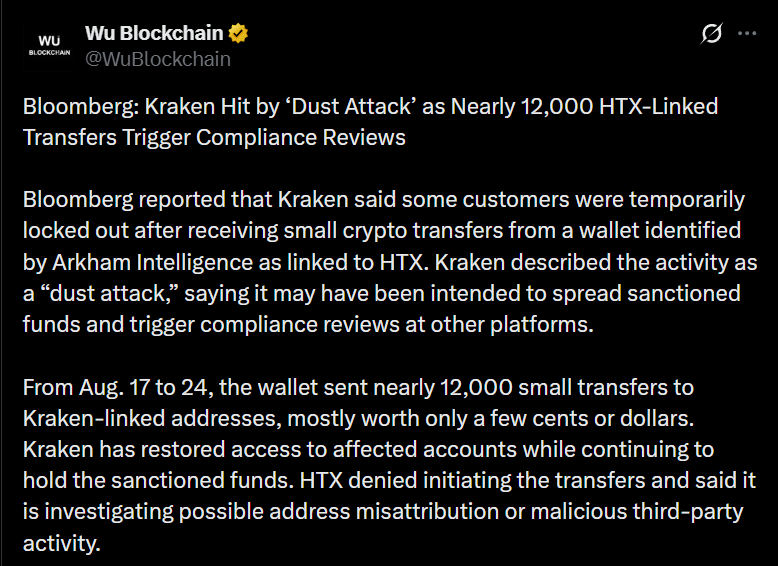
Source: WuBlockchain on X
Kraken said the activity came from a wallet linked to a sanctioned rival firm and described it as a dust attack, apparently designed to spread sanctioned funds and trigger compliance reviews across the industry.
What Actually Happened
Between August 17 and August 24, 2026, a wallet identified by blockchain analytics firm Arkham Intelligence as linked to that rival sent nearly 12,000 small deposits to addresses connected to the exchange, most worth only a few cents to a few dollars.
Arkham based its attribution on an address the firm had previously disclosed as part of its own proof-of-reserves process.
A company spokesperson said Kraken does not know who is behind the wave, but that the likely goal was for sanctioned funds to land in client accounts, triggering a full account lock and causing operational disruption for a large number of users.
The spokesperson added that once sanctioned funds land in a customer wallet, it typically forces an automatic freeze on that account, regardless of whether the customer requested or even noticed the incoming deposit.
Kraken said its compliance team mobilised quickly to restore access to affected accounts while continuing to hold the funds.
How A Dust Attack Actually Works
A dust attack works by sending extremely small amounts of cryptocurrency, often worth only a few cents, to a very large number of wallet addresses at once.
In most contexts, this tactic is used to try to de-anonymise wallet owners by tracking how the dust moves once it mixes with other funds.
In this case, Kraken believes the goal was different — namely, to place sanctioned crypto into as many customer accounts as possible so that automated compliance systems would flag and freeze those accounts.
Because blockchain transactions cannot be refused by a recipient, anyone holding a public deposit address has no practical way to block an unwanted incoming transfer before it lands in their wallet.
How the Platform Has Responded
The exchange has denied directing the transfers, pointing instead to possible address misattribution or activity carried out by a malicious third party unaffiliated with the platform.
Individuals closely associated with the firm, including TRON founder Justin Sun, publicly rejected the reports as fabricated, while a senior markets executive there said an internal investigation into the transfers was already under way.
The exchange has not confirmed any conclusion from that review as of this report.
Dust Attack Timeline At A Glance
Date | Event |
August 17, 2026 | The first wave of small deposits begins reaching exchange-linked addresses. |
August 17 to 24, 2026 | Nearly 12,000 dust transfers sent to exchange-linked addresses in total |
August 24, 2026 | Final transfers recorded before the pattern was flagged internally |
August 25, 2026 | Company confirms dust attack; account access restored |
Key Facts From This Kraken HTX News Update
Nearly 12,000 small transfers were sent to exchange-linked addresses over eight days
Most individual transfers were worth only a few cents to a few dollars
Affected customer accounts were temporarily locked as part of standard compliance protocol
Account access has since been restored for affected customers
Funds tied to the sanctioned wallet remain frozen and are not being returned or released
What This Means Going Forward
This round of Kraken HTX news highlights a growing risk for exchanges operating under strict sanctions regimes — namely that outside parties can weaponise small, unsolicited transfers to force automated compliance systems to freeze legitimate customer accounts.
Because recipients cannot refuse incoming blockchain transactions, this kind of dusting tactic could in theory be repeated against any exchange or wallet holder, regardless of their own conduct or intentions.
The company has restored account access for affected customers, though funds tied to the sanctioned wallet remain frozen while the platform continues its own compliance review.
Conclusion
This Kraken HTX news episode shows how a simple dust attack can ripple into a much larger operational and compliance disruption for an exchange and its users.
With the source of the transfers still disputed and an internal investigation reportedly under way, the underlying challenge — screening incoming crypto flows without punishing innocent customers — is likely to remain relevant well beyond this single incident.
Disclaimer
The information provided in this article is for informational and educational purposes only and should not be considered financial, investment, trading, or legal advice. Readers should conduct their own research and consult a qualified professional before making any financial decisions.









