Is Your Hardware Wallet Safe? What Coldcard Thefts Exploited

Is a Hardware Wallet Still Safe After the Coldcard Wallet Hack?
Is a hardware wallet still safe after the Coldcard wallet hack? Many crypto holders have asked this since July 30, 2026, when attackers started pulling bitcoin out of thousands of addresses linked to Coldcard devices. Forensic firms put the loss anywhere between $88 million and $116 million, and nobody has a final number yet.
Bitcoin itself wasn’t broken. Offline storage wasn’t disproved either. What failed was the way one company’s firmware made seed phrases. This guide covers how these devices work, what the Coldcard vulnerability really was, and which habits keep funds safer.
What Is a Hardware Wallet and What Does It Protect?
A hardware wallet is a small physical gadget that keeps the private keys for a person’s crypto. A private key is a secret code that proves who owns the coins on a blockchain. Since the key stays inside the gadget and never sits on a phone or laptop, viruses on a connected computer have a much harder time stealing it.
A crypto hardware wallet also signs payments on its own. The computer sends a request, the screen shows the details, the owner presses a button to approve, and only the signed result goes back out. Some models, Coldcard included, can even sign offline using a memory card, which is called air-gapped signing.
How Does a Hardware Wallet Create Its Seed Phrase?
Every device starts with a seed phrase, which is a list of 12 or 24 words that can rebuild every key on a compatible wallet. The firmware makes this list from random data, so the quality of that randomness matters more than anything else. When attackers can guess the random input, they can rebuild the phrase without ever touching the device.
Secure chips, PIN codes, and open-source firmware all add protection around the seed. None of them can fix a seed that was weak from the start.
What Was the Coldcard Vulnerability?
Researchers traced the Coldcard vulnerability to an error in random number generation. A firmware release from March 2021 made seed creation use a weak software generator in place of the dedicated hardware source. Reports say the seeds carried far less randomness than the planned 128-bit strength, as low as 40 bits in some cases.
Attackers then ran scripts that tried huge numbers of possible keys offline and matched them against public blockchain addresses. Funds could be moved without anyone holding the device. The flaw reportedly sat in public code for about five years before large thefts began.
Coinkite published a security advisory on July 31, 2026, one day after the first drains.
Why Doesn’t a Coldcard Wallet Update Fix Old Seeds?
A cold card hack update only fixes seeds made after the patch. A seed created under the faulty code stays guessable forever because the weakness sits in the numbers and not in the device. Fixed builds were released as 4.2.0 for Mk2 and Mk3, 5.6.0 for Mk4 and Mk5, and 1.5.0Q for the Q model.
Affected owners were told to make a new seed on patched firmware, or on a fresh device, and move every coin over. Any wallet made under the old code should be treated as unsafe. Early guidance named Mk3 devices first, so owners should check their model and firmware version in the official advisory.
What Is the Main Coldcard Lesson for Hardware Wallet Owners?
The biggest coldcard lesson is simple. Strong hardware means little when the code inside it is flawed. Open-source firmware lets the public inspect it, yet this bug went unnoticed for years, so public review alone offers no promise of safety. Spreading holdings across devices from different makers, built on different codebases, limits the damage if one of them fails.
Trezor and Blockstream Jade use separate codebases, so this exact flaw didn’t touch them.
How Can a Hardware Wallet Supply Chain Be Checked?
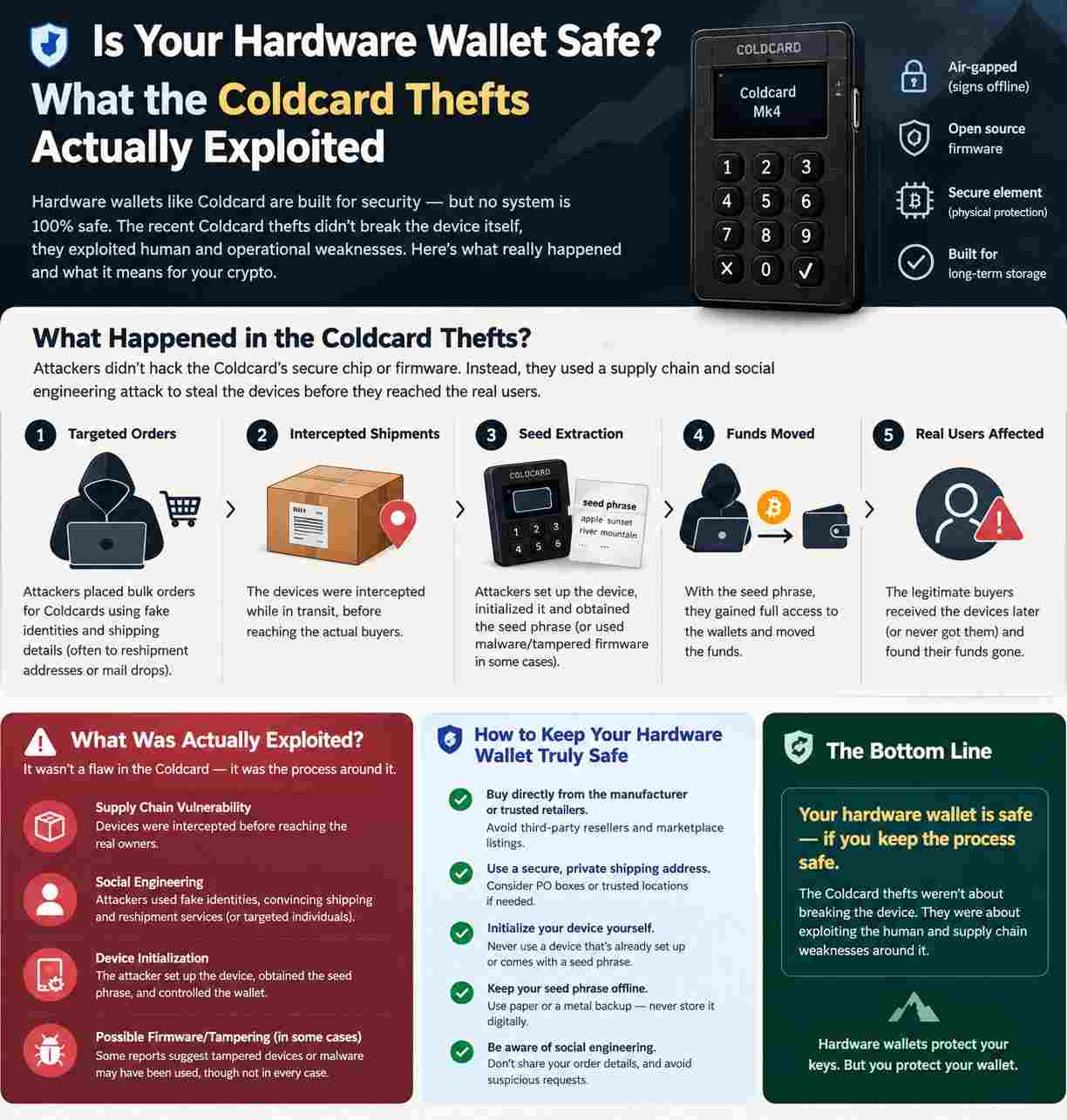
Hardware wallet supply chain risk is a different problem from the Coldcard flaw, though it matters just as much. A device can be opened, swapped, or loaded with a seed before it reaches the buyer. Anyone who types in a seed phrase that came inside the box has handed the keys to a stranger.
Buyers should order only from the official store or approved resellers and check the tamper-proof seals on arrival. A device that shows up already set up, or with a printed recovery card, should go back and never be used.
How to Set Up Hardware Wallet Devices Safely?
A careful setup takes under an hour and removes most of the avoidable risk. These steps work for any brand.
Install the latest official firmware before creating a seed.
Create the seed on the device itself and never import one from software.
Write the words on paper or steel and keep copies in separate safe places.
Never photograph, type, or cloud-save the phrase.
Test recovery with a small deposit before moving large amounts.
Which Hardware Wallet Scams Still Target Owners?
Hardware wallet scams grew after the news broke. Fake support accounts, copied websites and emails pretending to be official advisories push owners to enter recovery words or move funds to a “safe” address. Real makers never ask for a seed phrase, ever.
Fake devices sold on unofficial marketplace pages are another common trap. Some arrive with a seed that the seller already knows.
What Does the Data Say About Hardware Wallet Safety?
The stronger signal is that the failure came from random number generation, not from the chip, the screen, or Bitcoin. The main concern is that weak seeds give no warning, so affected owners could feel secure while attackers simply waited. The biggest unknown is still the true loss total, since forensic estimates differ.
Offline storage keeps its value, but trust in one maker should never be complete. Checking advisories directly with the manufacturer, splitting funds, and treating old seeds with doubt are habits the evidence supports. Court cases and new forensic findings may change the picture, so readers should verify current details on their own.
Conclusion
A hardware wallet is still one of the strongest ways to hold crypto privately, but the Coldcard wallet hack showed that good hardware can hide a weak software layer.
Seeds made under the faulty firmware needed replacing, and updates alone didn’t solve it. Careful buying, clean setup, and distrust of unexpected messages cover most of the remaining risk.
Disclaimer
This article is for informational purposes only and isn’t financial or investment advice. Crypto is high risk, and losses can be total. Readers should research on their own and speak to a licensed professional before acting.