PNC USDC Payments: Major US Bank Tests Stablecoin-to-Dollar System

PNC USDC Payments: How the New Stablecoin-to-Dollar Pilot Works
The latest PNC USDC payments update shows a major US lender taking a practical step into crypto.
On 9 November 2026, it began a limited pilot that lets selected business clients receive a dollar-backed digital token and end up with regular US dollars. Below is what was announced, how it works, and what remains unknown.
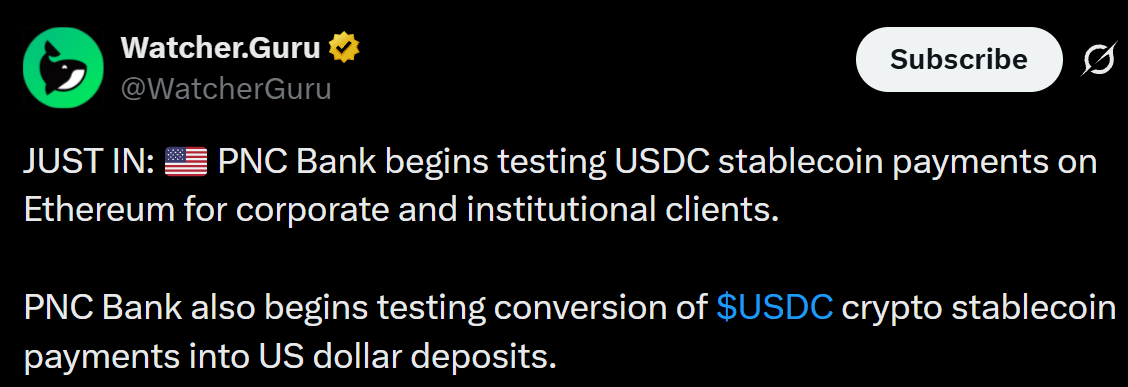
Source: Post on X
What the Bank Announced on 9 November
PNC Bank, one of the largest financial services firms in the United States, has made incoming USDC available to clients of its Corporate & Institutional Banking unit, according to its official announcement.
This unit serves companies and institutions. These clients can receive the token on the Ethereum blockchain, and the service is powered by Coinbase’s payment products.
Importantly, the offer starts on a limited basis for eligible clients only, as a pilot program. In short, this is a test run, not a rollout to every business.
How It Works, Step by Step
USDC is a stablecoin, meaning a digital token designed to stay equal in value to one US dollar. Ethereum is the public blockchain network it travels on.
The announcement describes this simple flow:
A customer, supplier, or partner sends the token to a PNC client over Ethereum.
The token is automatically converted 1-to-1 into US dollars, so each one becomes exactly one dollar.
The dollars are deposited into the client’s designated deposit account.
That is the core idea behind the new PNC USDC payments service. The client receives ordinary dollars in a bank account, and the conversion happens automatically.
Why Businesses May Find It Useful
The firm says the service is meant to help businesses get faster access to funds and work more efficiently on cross-border transactions, which means money sent between countries.
It also lets clients keep using the banking services they already rely on, and it adds to the firm’s existing faster-payment options rather than replacing them.
A senior treasury executive at the lender said clients are always looking for new ways to deal with customers, suppliers, and business partners, and that this option comes with the risk management and expertise they expect.
Treasury management simply means how a company handles its cash, from receiving money to paying bills.
Detail | What was announced |
Date | 9 November 2026 |
Who can use it | Eligible Corporate & Institutional Banking clients |
Token type | Dollar-backed stablecoin |
Network | Ethereum |
Conversion | Automatic, 1-to-1 into US dollars |
Where money lands | Designated deposit account |
Stage | Limited pilot program |
The main benefits named in the announcement are:
Faster access to funds
Greater efficiency for cross-border transactions
Continued access to regular banking services
Coinbase’s Role and a Growing Partnership
The service is powered by Coinbase, and the announcement says it builds on the firm’s existing relationship with the exchange.
That relationship includes the lender’s earlier launch of direct bitcoin access for clients in December 2025, which was powered by Coinbase’s crypto-as-a-service infrastructure.
Coinbase has also published its own post about the partnership. In the announcement, Coinbase’s head of infrastructure products said stablecoins are modernizing how businesses move money by making transfers faster, more efficient, and more global.
He added that this work shows how leading banks and digital asset infrastructure can come together.
For readers following PNC USDC payments, the key point is simple: a traditional lender is using crypto-industry tools while keeping the client experience inside a normal bank account.
What Is Still Unknown
The announcement is clear on the basics, but it leaves some questions open:
How many clients are in the pilot, and who counts as eligible
Any fees, limits or timing for the conversion
When, or whether, the pilot will grow beyond this first group
The lender says it is focused on helping clients understand and evaluate emerging payment technologies and see how they fit into their wider treasury plans.
Until more details are shared, readers should treat this as an early test, not proof of wide adoption.
Conclusion
In short, PNC USDC payments is a small but notable step: a large US lender is testing how businesses can receive stablecoin transfers and still end up with dollars in a normal account.
It remains a limited pilot, so watch for updates on who can join and how it grows.
Disclaimer
This article is for educational and informational purposes only and is not financial or investment advice. Crypto assets are high risk, their prices can be very volatile, and you can lose some or all of your money. Always do your own research and consider speaking with a licensed financial advisor before making investment decisions.






