Midterm Elections 2026: Key Contests and Crypto Regulation Outlook


What Should Voters Know About the Midterm Elections 2026?
Midterm Elections decide who writes America’s laws for the next two years, yet turnout is usually far lower than in a presidential race. In 2026, the vote lands on November 3, with every House seat and 35 Senate seats on the ballot. This guide explains what the elections are, how they work, which seats are up, what they mean for the president and why even crypto markets are watching. It also lists the dates and steps voters need before election day. Facts come from the U.S. Vote Foundation, Ballotpedia and recent news reports.
Key Takeaways
Election day is Tuesday, November 3, 2026, and all 435 House seats are up.
The Senate has 35 races: 33 regular seats and two special elections, in Florida and Ohio.
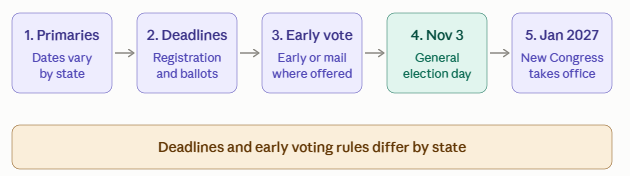
Deadlines and early voting rules differ by state, so each voter should check the state calendar.
What is a Midterm Election?
A midterm election takes place halfway through a president’s four-year term, two years after the presidential vote. The president and vice president are not on the ballot. Congress is.
Voters in every state also pick other offices, such as governors, state lawmakers and judges. Many ballots carry state-specific measures too.
What Is the Purpose of Midterm Elections?
The purpose of midterm voting is to re-balance power. Voters can back lawmakers who match the president’s agenda or ones who sit further from it.
Because the vote falls in the middle of a presidential term, the results are often read as a verdict on the president. Turnout in 2022 was 52.2%, lower than the midterm before it. The U.S. Vote Foundation calls that too low for such an important election.
Which Seats Are Up for Election in 2026?
Office | Seats up | Notes |
U.S. House | 435 | Every seat, two-year terms |
U.S. Senate (regular) | 33 | 13 held by Democrats, 20 by Republicans |
U.S. Senate (special) | 2 | Florida and Ohio, both held by Republicans |
Governors | 36 | 18 held by each party, 16 races open |
Ballotpedia counts 26 states with both a governor and a Senate race on the same ballot. Local offices and ballot measures vary by state.
When Are the 2026 Midterm Elections?
Voters get two chances to take part. Primaries come first, on dates that differ by state. The general election comes second, on the same day everywhere: Tuesday, November 3, 2026.
The midterm election date follows a rule from the 19th century. Federal elections fall on the Tuesday after the first Monday in November. November came after the harvest and before harsh winter. Tuesday gave farmers time to travel on Monday, after Sunday religious events. The Election Act of 1845 put the schedule in place across the country.
What Happens During Midterm Primary Elections?
Primaries choose each party’s nominee for each race. The winners then face each other in November.
Dates differ widely. Nearly all states have finished theirs by now, and some run runoffs. Georgia shows how long it can last: primary on May 19, runoff on June 16, general election on November 3 and a general runoff on December 1.
How Do US Midterm Elections Work?
Voters register in their state, then receive a ballot with federal, state and local races. House members are elected by district and serve two-year terms. Senators are elected statewide and serve six-year terms.
Winners take office when the new Congress begins in January. That body is the 120th Congress.
2026 US Election Date and Voting Deadlines
Item | What to know |
Election day | Tuesday, November 3, 2026 |
Voter registration | Deadline set by each state |
Mail ballot request | Deadline set by each state |
Mail ballot return | Rules on postmarks and receipt differ |
Early voting | Offered differently from state to state |
Voter ID at the polls | Rules differ by state |
Runoffs | Some states hold them after November, such as Georgia on December 1 |
The U.S. Vote Foundation keeps a state-by-state calendar of dates and deadlines.
Why Are the 2026 Midterm Elections Important?
Congress writes the laws, funds the government and confirms judges and senior officials in the Senate. Control of each chamber decides which bills move forward and which stall.
The Senate was split 53-45 in favor of Republicans in March, with two independents who side with Democrats. The balance can shift with a handful of seats. State races matter as well, since 36 governors are elected and many will shape local rules and budgets.
How Do Midterm Elections 2026 Affect the President?
A president whose party controls Congress can usually pass legislation more freely. When the other party gains power, obstacles grow. A president’s own party gaining seats reflects well, and losing seats makes it harder to enact an agenda.
A flipped chamber also changes oversight, hearings and the pace of confirmations.
What Could the Midterm Elections Mean for Crypto and Bitcoin?
Crypto has a direct stake in Congress, since Congress writes the laws that govern it. Republicans control the Senate, House and presidency. The GENIUS Act on stablecoins became law in 2025, while the CLARITY market structure bill has not passed.
Control of each chamber decides which crypto bills move forward and which stall.
Outcome | Possible crypto angle |
Same party keeps Congress | Bills like CLARITY could return, though the Senate needs 60 votes for most legislation |
Split Congress | Slower new laws, more hearings and oversight |
Either way | Regulators keep acting on their own |
How Bitcoin and the wider market react is not predictable. An analysis of Bitcoin and XRP around past midterm cycles finds mixed results from only three cycles, so it works as context, not a forecast. Uncertainty can weigh on prices, but interest rates, global demand and company news matter just as much. Nobody can promise a result.
How to Prepare for the Midterm Elections 2026
Check registration status and the state deadline.
Note the primary, general and any runoff dates.
Decide how to vote: in person, early or by mail.
Look up the voter ID rules for the state.
View a sample ballot to see every race and measure.
Find the polling place.
Sign up for state voter alerts.
Risks to Keep in Mind When Trading Crypto Around the Midterm Elections
Election weeks can feel exciting, but they are also when traders make rushed choices. A few simple habits can lower the risk.
Expect sharp, fast moves. Prices can jump or drop within hours on news, then settle. A big candle is not always a trend.
Avoid heavy leverage. Borrowed money can turn a small swing into a forced sale. Many traders cut leverage until results are clear.
Do not trade on headlines alone. Early results and rumors often change. Waiting for confirmed information usually costs less than reacting first.
Watch for scams. Election hype brings fake giveaways, “pro-candidate” tokens and fake exchange alerts. Only official websites and apps should be trusted.
Remember liquidity. Small and new tokens can be hard to sell in a rush, and prices can slip further than expected.
Check taxes and local rules. Crypto trading rules and tax duties differ by country and can change.
No one can say how the market will react around November 3. The safest plan is a small position, a clear exit and patience.
Final Word
Midterm Elections 2026 shape laws, budgets and oversight long after the votes are counted. The date is fixed, but the deadlines are not, so a few minutes with the state calendar can prevent a missed vote.
Disclaimer: This article is for information only and is not legal, financial or investment advice. Election rules and deadlines differ by state, so readers should confirm them with their state election office.