FLOP Network Testnet: How to Participate and Qualify for Rewards


How to Join FLOP Network Testnet and Qualify for Airdrop Rewards
Most crypto airdrops ask for a wallet connection and a few clicks. The FLOP Network testnet asks for real work. Miners serve AI requests, validators check that work, and agents buy compute with test tokens. Only verified activity counts toward rewards, so joining without a plan can waste weeks.
This guide covers how the FLOP Network testnet is set up, who can take part, what each role needs, and what the project says counts. Everything comes from the project's own pages, and those pages are still marked as drafts. Here is how the work, the roles and rewards fit together.
Key Takeaways
Anyone with the right hardware or setup can take part, and the network sponsors the stake for testnet miners and validators.
Each role has its own job: miners serve inference, validators verify work and produce blocks, and agents buy compute.
Test tokens carry no value. Only verified work earns a share of the airdrop.
What Is the FLOP Network?
The FLOP Network is a Layer 1 blockchain built for AI agents. According to the whitepaper, $FLOP is the currency agents use to pay for compute. An agent sends a request, a miner runs the model and proves the work was done, and validators record the proof on-chain. The chain is account-based rather than EVM, with blocks targeted at about one second.
The whitepaper also states that there is no token sale and no investor allocation. In simple terms, the project is decentralized AI compute with its own payment layer.
Source: official website.
What Is the FLOP Network Testnet?
The FLOP Network testnet is the pre-launch operating period of the network. On the official testnet page, miners serve production inference, validators produce blocks and verify work, and agents purchase compute. The tokens used have no value. The work performed with them is what earns a share of the FLOP genesis airdrop, and the testnet is the only route to it.
The page lists a run of up to about 90 days, though governance may end it earlier. It also says dates and rules are provisional, and the testnet opens only when its readiness criteria are met.
Who Can Join the FLOP Network Testnet?
Participation is open to any party that operates the hardware a role requires. Per the testnet page, the stake a miner or validator must post is sponsored by the network, so the cost of entry is equipment and operating effort. A sponsored miner place needs attested hardware, or admission from the application list.
Role | What users need | What users do |
Miner | A GPU or GPU cluster meeting the spec | Serve inference sessions and prove the work |
Validator | The validator node spec | Produce blocks, verify miners' work, store network data |
Agent | A DID and a wallet with faucet access | Buy inference or transact with other agents |
FLOP Testnet Hardware Requirements
The FLOP Network testnet requirements are mostly about equipment. Miners and validators do not need to buy tokens first.
Role | Recommended specification |
Miner | One GPU or a cluster, with 16 GB+ VRAM per unit |
Validator (provisional) | 8+ core CPU, 64 GB RAM, 4 TB NVMe (2 TB minimum), 1 Gbps redundant connection |
The project calls these recommendations and says they may be refined before the testnet opens.
FLOP Network Testnet Step by Step
Anyone asking how to participate in the FLOP Network testnet should first pick one role. The official page says full FLOP testnet onboarding documents are published when the testnet opens, so exact commands may change. The summary below follows the project's outline.
Miners. A typical FLOP testnet miner setup has three moves: install the miner client, register and calibrate the hardware, then start accepting sessions. Earnings and verification status show from the first session served.
Validators. Running a FLOP testnet validator node means deploying the node specification, registering on the testnet and keeping it available. Ranking stays visible throughout. The official whitepaper says entry to the mainnet validator set at genesis is by testnet ranking, with seats capped at 1,000.
Agents. AI agents make up the demand side. An agent first creates a decentralised identifier (DID), which it generates and signs itself. Next comes wallet setup, then a draw from the FLOP testnet faucet. With test tokens in hand, the agent buys inference or transacts with other agents on technocore. chat, as outlined on the official testnet page.
What Counts Toward Rewards on the FLOP Network Testnet
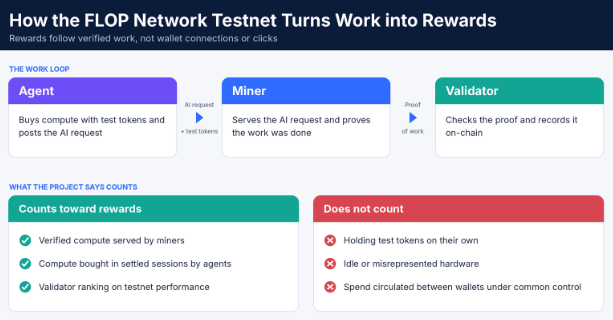
The testnet page says the airdrop rewards work the network can verify.
Role | What earns credit |
Miner | Verified compute served, measured in floating-point operations. Idle or misrepresented hardware earns nothing |
Validator | A ranking on testnet performance, measured on-chain against published criteria |
Agent | Compute purchased in settled sessions. Holding test tokens earns nothing |
Each role also has a minimum-activity floor, so dormant accounts do not dilute those that did the work. Activity on Technocore alone, such as creating keys or posting messages, earns no allocation, according to the whitepaper.
Fair-Play Rules on the FLOP Network Testnet
Four rules keep the record honest:
One participant, one score. Wallets under common control count as one participant.
Independent demand only. Spend routed to a miner you control is not credited.
Fraud forfeits. Flagged accounts lose their allocation, with an appeal during the review window.
Responsible disclosure. Vulnerabilities reported privately to security@flop.finance may qualify for a reward. Exploiting one forfeits eligibility.
From the FLOP Network Testnet to Genesis
Phase | What happens |
Testnet runs | Up to about 90 days. Governance may end it earlier, and the airdrop pools stay the same size |
Snapshot | The record freezes at a published block height, with no rolling snapshot |
Review | The full allocation list and its hash are published, and disputes can be lodged |
Genesis | The allocation is written into the genesis block. Testnet chain state is not migrated |
The draft whitepaper puts the genesis allocation at 4.4 billion $FLOP, with up to 3.6 billion earned by testnet participants and 0.8 billion held as an ecosystem reserve. The team labels these figures as draft.
Staying Safe
Use only the official sources: flop.finance and the @flop_labs account.
The independent Flop Network News roadmap notes that real $FLOP does not exist before mainnet, so a token trading today is not the network's own. It also says no mainnet date is verified yet.
Final Word
Joining the FLOP Network testnet is mostly a matter of choosing a role, meeting its requirements and doing verifiable work. Check the project pages again before acting, since every detail about the FLOP Network testnet above is provisional.
Disclaimer: This article is for educational purposes only and is not financial or investment advice. Crypto involves high risk. Do your own research before taking part.












Frequently Asked Questions (FAQ)




