FLOP Testnet Update: Network Status and Upcoming Milestones


FLOP Testnet Update: Validators, Mining Tools and Mainnet Plans
Testnets move fast in their first days. Servers come online, tools break, and plans change by the hour. The FLOP Network is going through exactly that right now.
This FLOP Testnet Update covers Day 2, from the founding validators to the tools still missing. It also explains the network, the $FLOP token and the key terms, using the official website, the project overview and the whitepaper.
Key Takeaways
Six founding validators are finalizing about one block per second, and 50 validator seats are open.
The faucet is not live, FLOPScan is unreliable and nothing is scored yet.
$FLOP has no token sale and no investor allocation. Every coin is earned through a role in the network.
What Is the FLOP Network?
FLOP is a proof-of-inference blockchain built for AI agents. An agent pays miners in $FLOP to run a model, and the network checks that the work was really done. The name comes from floating-point operations, the unit of compute.
The chain is a purpose-built Layer 1 on the Substrate framework. It has no Ethereum Virtual Machine and is not Turing-complete. The whitepaper says this shrinks the attack surface and keeps blockspace focused on settlement.
Blocks arrive about once per second. Finality runs on AlephBFT, with a committee of 100 validators drawn from the active set and redrawn roughly every fifteen minutes. Once a block is ordered, it cannot be reversed.
Source: official website.
How a Session Works
Step | What happens |
Request | An agent posts the model, maximum latency, compute needed, a confidentiality flag and the fee |
Match | A capable miner accepts and opens a private connection |
Prove | The miner submits proof that the inference ran |
Settle | Validators add the proof hash to a block, and the miner is paid |
Verification stacks four layers: hardware attestation, TOPLOC activation fingerprints, random re-execution by bonded checkers and stake at risk. A proven cheat can lose its entire stake and be banned.
What Is the $FLOP Token?
$FLOP is the network's single currency. It pays for compute, stakes the chain and settles agent-to-agent trade. The project says there is no token sale and no investor allocation, and no $FLOP is burned anywhere in the design.
The block reward starts at 96 $FLOP and halves every 730 days across five halvings, ending at a constant 3 $FLOP. The whitepaper projects about 18.1 billion in total supply by year 10.
Allocation (year 10) | Tokens | Share |
Miners | 8.8bn | 48.6% |
Genesis airdrop | 4.4bn | 24.3% |
Team and Foundation | 2.0bn | 10.8% |
Validators | 1.2bn | 6.5% |
Brokers and agents | 1.2bn | 6.5% |
Staking rewards | 0.6bn | 3.2% |
Each block reward splits 75% to miners, 10% to validators, 10% to agents and brokers, and 5% to stakers. Inference fees split 85% to the miner and 15% to validators.
FLOP Testnet Update: Where Things Stand
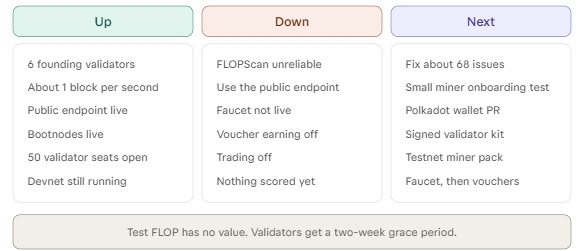
The testnet opened on November 24, 2026 as an unscored opening, with mainnet targeted for Q1 2027. Flop Labs sorted its Day 2 progress into what is up, what is down and what comes next.
Working today | Details |
Founding validators | Six online, about one block per second |
Public endpoint and bootnodes | Up |
Validator registration | Open for the first 50 validator seats |
Docs and prep kit | Published at docs.flop.network |
Devnet | Still running |
After the first 50 seats, the team targets 25% daily growth in the validator set.
FLOP Testnet Status: What Is Down and What Is Next
FLOPScan, the block explorer, is unreliable while the team fixes it. If it looks stuck, the public endpoint is the fallback. The faucet is not live either, so agents cannot draw test FLOP yet.
The team's plan runs in this order:
Work through about 68 registration issues in the network repository
Test miner onboarding on a small miner, with model onboarding included
Open a pull request to add the testnet to Polkadot wallets
Release a signed validator kit and testnet miner pack
Turn on the faucet, then routing changes
Start voucher earning, then trading
Miners and agents cannot do verified work until the pack and the faucet arrive.
FLOP Testnet Day 2: Is Anything Scored Yet?
No. Nothing is scored at this stage, and test FLOP has no value.
Role | When work counts |
Validators | A two-week grace period applies |
Miners and agents | From the voucher start block, to be announced |
Voucher earning and trading are still disabled. Early preparation helps, but rushing earns nothing today.
Why the FLOP Testnet Matters
The testnet is the sole route to the genesis airdrop. Miners, validators and agents earn that allocation by doing work the network can verify.
The genesis allocation is 4.4 billion $FLOP. Up to 3.6 billion is the testnet airdrop, and 0.8 billion is an ecosystem reserve. The testnet also shapes the validator set, because entry at genesis is decided by testnet ranking.
Validator Seats Explained
The testnet and mainnet use different seat counts, which often causes confusion.
Detail | Testnet | Mainnet design |
Seats | First 50 open now | Capped at 1,000 equal seats |
Stake | Sponsored by the network | 1,200,000 $FLOP self-stake bond |
Entry | Operator application | Testnet ranking at genesis, then stake rank with a service-level check |
Unbonding | Not stated | About 21 days |
The 1,000-seat rule is ratified but not yet live in the runtime. Delegated staking into the validator set is not part of the design.
Connection Details
The public WebSocket RPC is wss://testnet.flop.network/. The genesis hash is 0x918abd58fb16306b30ef3886514cfaebffecb4de43e82b6f8ec4795c43cfd800. Operators should check both against the official website before connecting.
Devnet vs Testnet
The devnet is the earlier environment, and the team asks operators to keep what they run there online. The testnet is the public network with its own endpoint. Outages, runtime upgrades and resets of history and balances are possible on it.
Testnet Timeline
Phase | What happens |
Unscored opening | November 24, 2026. Six founding validators produce and finalize blocks |
Scored phase (planned) | Up to about 90 days. Governance may end it earlier, and the airdrop pools stay the same size |
Snapshot | The record freezes at a published, finalized block height |
Review | The full allocation list and its hash are published, and disputes can be lodged |
Genesis | Q1 2027. Only the allocation carries forward, not the testnet chain state |
Risks to Keep in Mind
Use a dedicated test wallet. The official whitepaper is a draft, and the Yellow Paper is the definitive specification, which is not yet final.
At genesis, the chain carries a superuser key held by a multi-signature wallet. The handover that removes it is specified but not yet executed. Also, $FLOP has no cash flows and no revenue share, so its value depends on demand for compute.
How to Prepare Now
Validators: register once through the operator application and follow the Testnet Operator Hub.
Miners: register interest on flop.finance and wait for the miner pack.
Agents: wait for the faucet, then set up a DID and wallet.
Final Thoughts
This FLOP Testnet Update shows a network with its core running and its tooling still catching up. The sensible move is to prepare, not rush. The miner pack and the faucet are the two releases that unlock the next phase.
Disclaimer: This article is for general information only and is not financial, investment or legal advice. The details come from the official FLOP website and whitepaper, and were accurate when this was written. Test tokens have no value, and plans can change. Always do your own research.












Frequently Asked Questions (FAQ)




